From Headscarf to Apron: Five Layered European Women's Folk Costumes
Published · updated
A white scarf on the head, a red vest over a blouse, and below, a skirt striped in blue and brown. It looks like a single garment, but it is actually several pieces, each made separately and worn in layers. In layered clothing from the Balkans we saw how aprons and vests were layered together. These five pieces show how differently that approach played out in color and combination across Europe. The last two are a jacket and a dress photographed together in a single picture.
| Work | Components | Period |
|---|---|---|
| Dress | One dress | Late 19th century |
| Ensemble | Headscarf + vest + skirt | Mid-19th century |
| Ensemble | Eight parts, including veil, blouse, vest, skirt and front panel | Late 19th century |
| Dress and jacket (one photo) | Dress and jacket, two accession numbers | 1840–80 |
Color only at the collar
 Solve this painting as a puzzle → about 5 minutes on Easy
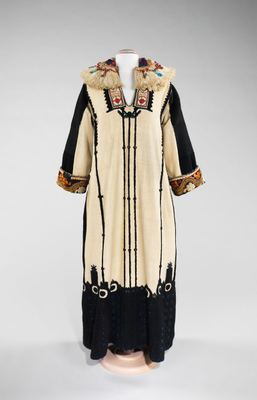
The Dress is cream wool embroidered in black thread with vertical lines and small motifs. Around the neck is a wide collar embroidered in red and blue and trimmed with tassels. Black line embroidery on a cream ground is a technique seen in Balkan and Eastern European women’s clothing: color is used sparingly, and all the richness is concentrated on the collar and sleeves. The tassels and beads on the collar mark it as festival wear. The black cloth at the hem is a bit of household wisdom, so that dirt shows less.
On this dress the colored pieces at the collar and cuffs are the most distinct, so start there. Build the frame with the black hem and the outline of the mannequin, and sort the cream pieces left from right by where the black vertical lines fall. 48 pieces is about right.
Striped skirts that told where you were from
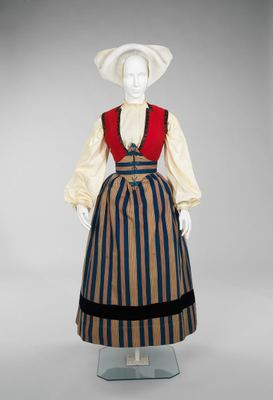
The Ensemble is the outfit described at the very beginning: a white headscarf, a red vest over a white blouse, and a skirt with vertical blue and brown stripes. The pairing of a white headscarf with a striped skirt appears in rural women’s clothing in many regions of 19th-century Europe, and the color and width of the stripes could tell you which district someone came from. The red vest is a sign of festival dress. The black velvet band at the hem of the skirt strengthened the edge while also serving as decoration.
White, red and blue divide neatly into three zones, which makes it easy to solve. Put together the red vest and white headscarf first, then join the striped skirt along the direction of the stripes. 48 to 100 pieces is about right.
A dance cloth embroidered “Breaza”
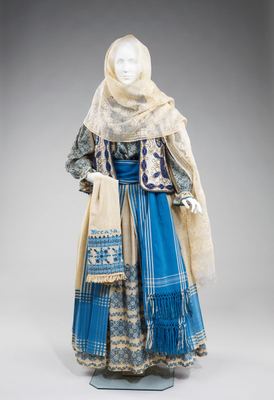
Another ensemble has one more layer. A cream veil covers the head and shoulders, with a gray-blue blouse with a fine pattern, a white vest with blue leaf motifs over it, and a blue sash at the waist. A blue cloth with white stripes hangs down the front, finished with knotted tassels, and between its panels you can see a cream skirt embroidered with bands of blue geometric pattern. The cloth draped over the arm is embroidered in blue thread with the word “Breaza.” Following the accession numbers, eight parts make up the one outfit. The museum record gives no region, but “Breaza” on the cloth matches the name of a town in Romania, which offers a clue to where it came from.
The cream veil, the blue front panel and the white vest are clearly distinct, so start with the outline of the veil and the vest. Join the blue front panel by following the direction of the white stripes and the knotted tassels at the bottom. 100 pieces is about right.
Two catalog entries in one photograph
The last two pieces were originally one outfit but were split into two entries in the collection catalog. Since there is only one photograph, they are solved together as a single puzzle.
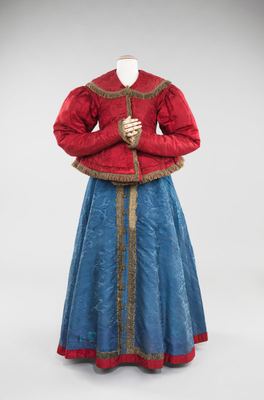
The blue dress and red jacket were photographed layered on a mannequin. The blue patterned silk dress underneath has two rows of metallic lace bands and round buttons running down the center front, with red and metallic bands around the hem. The red jacket on top has a large rounded collar that covers the shoulders. The sleeves puff out widely at the shoulder and narrow at the forearm, and metallic thread tassels run along the collar, the front opening and the cuffs. The records show that the dress and jacket received consecutive accession numbers and were purchased together by the Brooklyn Museum in 1918. No region is recorded, but the sleeves that puff out so widely at the shoulder resemble a shape that was fashionable in Western European women’s dress in the 1830s.
The colors divide the picture clearly into top and bottom. For the dress, start with the gold vertical bands and the red band at the hem; for the jacket, start with the gold tassel pieces at the collar and cuffs. 100 pieces is about right.
Made separately, worn together
After these five pieces, it becomes clear once again that European women’s folk dress was not cut as a single garment. Headscarf, vest, skirt and apron each existed separately and came together on one body according to the formality of the day. Even the catalog splitting the jacket and skirt into separate entries is, when you think about it, a direct result of this principle of combination.
Set these beside the embroidery in the Eastern European embroidery tour and the series on Hungarian shepherds’ winter coats, and you can sense how many hands and how much time it took to assemble a single outfit in the 19th-century European countryside. A new vest one year, an embroidered cloth another, and the layers built up over several years became one person’s dress.