Embroidered sampler
A long, narrow band sampler that Mary Griffits, about fourteen, finished in 1727, with alphabets, verses and floral bands running from top to bottom. Full commentary ↓
Couldn't load the puzzle image.
Turn on piece outlines to see piece positions on this picture too
Drag the pieces into place · When zoomed in, drag an empty spot to move around
You can also play with a keyboard — Tab to the board, thenSpace pick a piece, Arrow keys move it (with Shift for small steps),Esc deselect, R rotate a piece (Shift+R the other way)
Embroidered sampler is a textile by Mary Griffits (1727) in the collection of The Metropolitan Museum of Art. It measures 89.5 × 15.2 cm.
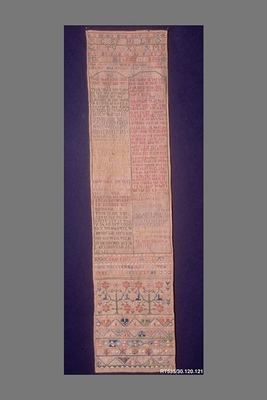
In the pictureOn a long, narrow strip of linen about 15 cm wide and nearly 90 cm long, embroidery runs in bands from top to bottom. Most of the upper part is letters and verses stitched in red and brown thread, and lower down come colorful bands of flowers, birds and geometric patterns. The colors have faded with time, giving the whole a pinkish and brownish cast.
BackgroundSuch "band samplers" were made by girls learning needlework in 17th- and 18th-century England and America, and served as a textbook in which techniques were mastered one at a time, working from top to bottom. Mary Griffits was born around 1713, so she was about fourteen when she finished this sampler in 1727. Thanks to the custom of stitching one's name together with the year, a girl's name has come down to us from 300 years ago.
Puzzle tipThe image is extremely tall, so the pieces come out narrow and long. Each band differs in color and pattern, so the first step is sorting the pieces band by band. In the lettered sections, judge top and bottom by line spacing and color rather than by the letters themselves; the floral bands at the bottom have distinct colors and are good to complete first.
- Artist
- born ca. 1713
- Classification
- Textiles
- Medium
- Linen embroidered with silk thread
- Dimensions
- 89.5 x 15.2 cm
- Credit line
- The Sylmaris Collection, Gift of George Coe Graves, 1930
Source: The Metropolitan Museum of Art ↗
Stories about this work
- Why Embroidered Samplers Still Carry the Names of Girls from Centuries Ago
European embroidered samplers often carry the maker's name and the year she finished, stitched in together. The personal traces you meet as you assemble them as puzzles.
Puzzles to try next
More European Embroidery & Costume puzzles· Stories and puzzle tips