Why Embroidered Samplers Still Carry the Names of Girls from Centuries Ago
Published · updated
A square of cloth with rows of alphabet letters and, below them, embroidered flowers, birds and houses. Browse the European Embroidery & Costume category and you come across pieces of cloth like this again and again. They are called samplers. Here we look at three of them, finished by three girls in 1727, 1824 and 1827.
A Name Left in the Corner of a Practice Sheet
Samplers were not made as works of art to begin with. They were practice pieces and pattern references. Girls in 17th- to 19th-century Europe and America learned needlework by embroidering the alphabet, numbers and basic patterns in turn, and once their hands were practiced they moved on to more complex designs such as houses, trees or Bible verses.
But samplers often have the maker’s name and the year of completion stitched in together. For these three, too, the collection records list the maker as the artist and even give a birth year, so their ages can be worked out. Mary Griffits was born around 1713, Anne Fazackerley in 1811, and Hannah Bloomfield in 1813. They put down their needles at about fourteen, thirteen and fourteen, respectively. This was a time when it was hard for a woman’s name to survive as an artist’s. It was precisely because these were practice pieces by some family’s child that the names have lasted to this day.
Band, Landscape, Pattern Sheet: Three Girls, Three Kinds of Cloth
 Solve this painting as a puzzle → about 5 minutes on Easy
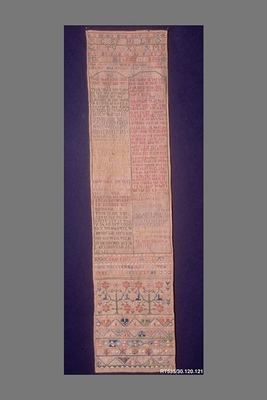
Mary Griffits’s sampler is a long, narrow band 15.2 cm wide and 89.5 cm long. According to the collection record, it is embroidered in silk thread on linen. European band samplers of the 17th and 18th centuries were long strips of cloth on which patterns were stacked one band at a time, so they served both as the maker’s practice sheet and as a pattern book for keeping designs. Reading down from the top, there are several rows of alphabet, then a line that reads as an instruction to fear God and honor the king, and then the Ten Commandments take up the widest space. English letters are packed into compartments modeled on two stone tablets. Below that are her name and the year 1727, and at the very bottom lie bands of red flowers and trees and geometric bands repeating triangles and diamonds.
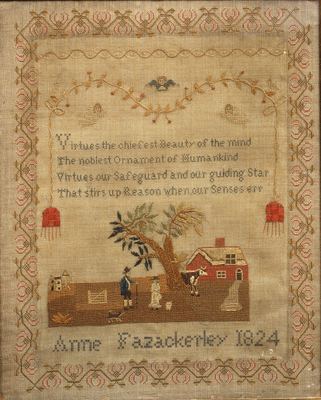
Move on to Anne Fazackerley’s sampler of 1824 and the format changes completely. A red floral border surrounds a slightly tall 45.1 × 37.5 cm cloth; at the top inside are a garland of vines and small winged figures, with red tassels hanging from both ends of the garland. In the center is a four-line poem. It begins “Virtues the chiefest Beauty of the mind” and says that virtue is a person’s greatest beauty. Below the poem a landscape spreads out: trees and a red house, a cow, a man in a blue coat and a woman in white, and a small dog. The collection record says it is embroidered in silk and chenille on a wool ground; chenille is a thick, plush thread, so the leaves look puffed up like down. At the very bottom: “Anne Fazackerley 1824.”
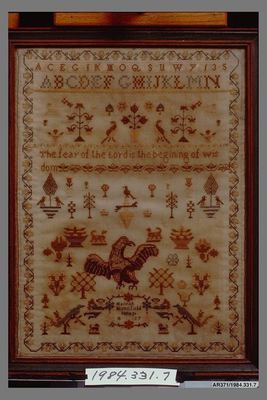
Hannah Bloomfield’s 1827 sampler differs again from the landscape type before it. It is less a picture of a scene than a pattern sheet. The top row stitches the alphabet skipping every other letter, A C E G…, with numbers added at the end, and the row of large capital letters below it stops at N. Next come flowering trees and birds standing in mirror symmetry, and the Bible verse “The fear of the Lord is the beginning of wisdom” is split at the end of a line into wis and dom, running over two lines. In the lower center is a large bird with wings spread wide, apparently an eagle, with baskets, trees and small four-legged animals scattered around it. The name and date are placed inside a small garland at the very bottom. The thread is mostly in browns and oranges; only the birds in the two lower corners are blue-gray.
Cloth Where Color Works, Cloth Where You Have to Look at Shape
Each of the three takes a different approach. The difference starts with how well sorting pieces by color works. Anne Fazackerley’s sampler has many clearly colored elements, the red border, red house, red tassels and blue coat, so color sorting works first. At 48 pieces, the edge alone is 24 pieces, half the total. The red floral pattern repeats at regular intervals, so it all looks alike, but at the corners the vines cross in a different way, which lets you tell them apart. The four lines of the poem are evenly spaced, so they settle top and bottom, and the name line is a sure sign of the very bottom.
Hannah Bloomfield’s sampler is all in a single range of browns and oranges, so it does not divide well by color. Look at shape instead. Because the design is symmetrical, the same flowering trees and birds come in pairs, and the work is figuring out which side each belongs to. Fortunately, the large bird and the name garland anchor the center, and the dark wooden frame caught in the photograph and the white accession number label at the bottom serve as references for the edges.
The oddest is Mary Griffits’s sampler. The puzzle image is a photograph in a 2:3 ratio, with the long cloth standing in the middle. The surroundings are a gray and dark navy ground, so roughly 70% of the picture is background, not cloth. At 24 pieces (4 across, 6 down), the two outer columns on the left and right, twelve pieces, do not touch a single thread of the cloth. In those pieces, the only thing to go on is the one line where gray meets navy. The pieces the cloth does cross, by contrast, divide neatly band by band. The floral band at the bottom has clear colors and is good to finish first; for the Ten Commandments in the middle, use the spacing of the lines of text, and the point where the gray thread of the left tablet gives way to the red thread of the right, to settle top and bottom.
Before a Cloth You Would Have Passed in Seconds
I wrote earlier that puzzles make you look at a picture for a long time. Few things benefit from that as much as samplers. In front of a museum display case, they are the kind of thing you would pass in a few seconds, thinking “old embroidery.” But as you fit the pieces, you see everything: the spot where Hannah’s wisdom breaks in two at the end of the line, the rows where Mary pressed letters firmly into the tablet compartments, the way Anne’s leaves rise thick, thread by thread.
More samplers with names are in six samplers from 1735 to 1823, and one whose name was cut away can be seen in two spoons and a nameless deer sampler. Still, what stays longest from these three is Hannah’s split word. It is as if you catch a brief glimpse of the fourteen-year-old’s hand deciding, with the line running out, to cut wisdom in half.