Embroidered sampler
An 1813 sampler stitched with a six-line moral verse on the fleetingness of time and flowering trees, Mary Ann Reed's name framed in a ring of leafy vine. Full commentary ↓
Couldn't load the puzzle image.
Turn on piece outlines to see piece positions on this picture too
Drag the pieces into place · When zoomed in, drag an empty spot to move around
You can also play with a keyboard — Tab to the board, thenSpace pick a piece, Arrow keys move it (with Shift for small steps),Esc deselect, R rotate a piece (Shift+R the other way)
Embroidered sampler is a textile by Mary Ann Reed (1813) in the collection of The Metropolitan Museum of Art. It measures 48.3 × 38.1 cm.
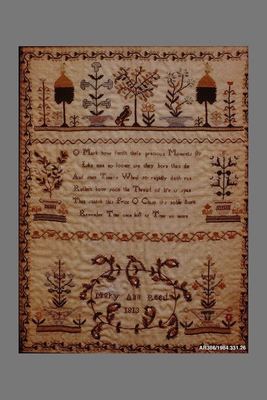
In the pictureInside a vine border, zigzag bands divide the field into three tiers. In the top tier, potted flowering trees and a single black bird sit between two brown, dome-shaped trees with rounded tops; in the middle tier, potted flowering trees flank six lines of verse worked in brown thread. In the center of the bottom tier, "Mary Ann Reed 1813" sits inside a ring of leafy vine, with flower baskets standing symmetrically on either side. The thread is mostly brown, black and ocher, and the green and pale blue have faded. The whole cloth is rippled with wavy creases.
BackgroundThe verse begins "O Mark how swift these precious Moments fly" and, by way of the wheel of time and the thread of life, ends with a line saying that lost time never returns. Moral verses urging people not to waste time were often stitched on samplers. The record gives neither her age nor her birth year, so it is not known how old she was when she made it. At 48.3 × 38.1 cm, it is a little larger than Harriet Cates's 1823 sampler (43.2 × 36.8 cm), given by the same donor in 1984, and ten years earlier. Where that sampler is showy with its picture of a red house, this one is quiet, centered on text and plant motifs.
Puzzle tipThe three tiers are divided horizontally by zigzag bands, so fitting the band pieces first sets up the zones. The two brown dome trees in the top tier and the ring of leafy vine in the bottom tier are the most noticeable reference points. In the middle verse area the lines of lettering look alike, so match heights using the potted trees on either side. Tell the pale ground pieces apart by the direction of the shadows in the cloth's creases. Put the outer black edge and gray margin around last. 100 pieces works well.
- Classification
- Textiles
- Medium
- Embroidered silk on wool
- Dimensions
- 48.3 x 38.1 cm
- Credit line
- Gift of Barbara Schiff Sinauer, 1984
Source: The Metropolitan Museum of Art ↗
Stories about this work
- From 1735 to 1823: Five Signed Embroidered Samplers and One Building
From 13-year-old Mary Pearce to 6-year-old Harriott Cates, five English embroidered samplers spanning 90 years, plus one exception that stitched a building instead of a name.
Puzzles to try next
More European Embroidery & Costume puzzles· Stories and puzzle tips