Frontispiece - Yvette Guilbert before the Prompter's Box
The singer Yvette Guilbert beside the prompter's box on stage, with her signature. A lithograph Toulouse-Lautrec made in 1898 as an album frontispiece. Full commentary ↓
Couldn't load the puzzle image.
Turn on piece outlines to see piece positions on this picture too
Drag the pieces into place · When zoomed in, drag an empty spot to move around
You can also play with a keyboard — Tab to the board, thenSpace pick a piece, Arrow keys move it (with Shift for small steps),Esc deselect, R rotate a piece (Shift+R the other way)
Frontispiece - Yvette Guilbert before the Prompter's Box is a print by Henri de Toulouse-Lautrec (1898) in the collection of The Metropolitan Museum of Art. It measures 50.2 × 37.8 cm.
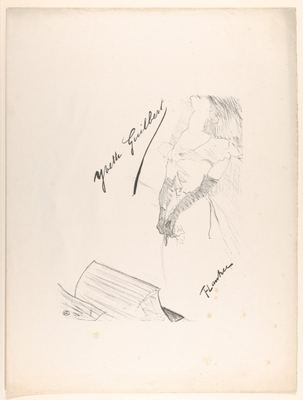
In the pictureOn almost blank white paper, a woman's profile is drawn in a few black lines. There are only the outlines of a long-gloved arm, upswept hair, and shoulders, and in front of her the prompter's box, set into the stage floor, sits at an angle. On the left is the large signature "Yvette Guilbert," and at the lower right, small, the artist's signature.
BackgroundYvette Guilbert was a star singer of the Paris café-concerts of the 1890s, and her trademarks were long black gloves, a thin figure, and exaggerated expressions. Lautrec drew her countless times, and this print is the first page of the second Yvette Guilbert album, published in London in 1898. It catches her standing beside the prompter's box, set into the floor at the front of the stage to feed actors their lines; Lautrec's skill lies in using lines so sparingly while still making the figure instantly recognizable.
Puzzle tipBecause the paper is nearly blank, this is among the hardest kinds of puzzle. If you pick out every piece with a line on it, you will have only ten or so, and the rest must be fitted by faint stains on the paper and piece shape alone. 24 pieces is recommended, and running the shadowed pieces at the paper's edge around first, then filling the inside, is about the quickest way.
- Artist
- French, Albi 1864–1901 Saint-André-du-Bois
- Classification
- Prints
- Medium
- Lithograph on laid paper
- Dimensions
- 50.2 x 37.8 cm
- Credit line
- Gift of Mrs. H. Wolf, 1917
Source: The Metropolitan Museum of Art ↗
Stories about this work
- Yvette Guilbert, Drawn Twice by Toulouse-Lautrec Four Years Apart
The 1894 Paris edition puts text and image on one page; the 1898 London edition keeps only a few lines. Lautrec's restraint, seen through two versions of the same singer.
- Three Works on Paper We Skipped from Goya, Lautrec and Degas Series
Plate 8 of Goya's bullfight series, Lautrec's Yvette Guilbert album cover and a Degas bather study: three works earlier posts missed, picked up here.