Three Works on Paper We Skipped from Goya, Lautrec and Degas Series
Published
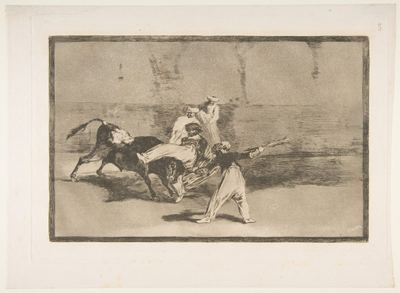
In an empty bullring, a bull lifts a man on its horns. This is plate 8 of Goya’s “La Tauromaquia.” Series are often introduced through one or two famous works and left at that. Here too, in covering Goya’s bullfight prints and Degas and Lautrec drawings, we passed over some other scenes from the same series. This post picks up those three missing pieces. If you have read the two earlier posts, you can treat this as a sequel.
| Work | Artist | Date | Medium |
|---|---|---|---|
| A Moor Caught by the Bull in the ring, plate 8 from “La Tauromaquia” | Goya | 1816 | Etching, aquatint |
| Frontispiece - Yvette Guilbert before the Prompter’s Box | Toulouse-Lautrec | 1898 | Lithograph |
| Bather Sponging Her Knee | Degas | ca. 1883–84 | Charcoal, pastel |
Plate 8, Left Out of “La Tauromaquia”
 Solve this painting as a puzzle → about 5 minutes on Easy
The bullfight prints post covered plate 10 of “La Tauromaquia.” This print is number 8 in the same series. While the bull lifts one man, another man rushes in from the right with a lance.
The early plates of “La Tauromaquia” depict the legend that traces the origins of Spanish bullfighting to the Moors (the Arab inhabitants of Spain in the Islamic era). This scene is the moment a Moorish bullfighter is caught by the bull. Goya preferred to depict accidents and danger over heroic triumphs, and this plate is no exception. The black lines of the figures stand out against the gray tone laid down in aquatint.
The whole print is in gray tones, so you solve the puzzle by shape. Assemble the dark pieces of the bull and the two figures first, then divide the background into the dark gray above and the pale sand below. 48 pieces is about right.
Yvette Guilbert Beside the Prompter’s Box
The Degas and Lautrec drawings post covered another print in which Lautrec depicted the singer Yvette Guilbert. This one is the cover of an 1898 album, its first page.
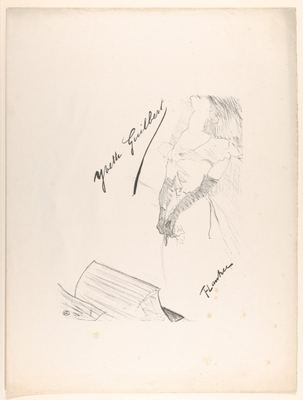
A woman’s profile is drawn in a few black lines on almost white paper. An arm in a long glove, upswept hair and the outline of a shoulder are all there is, and in front sits the prompter’s box set into the stage floor, at an angle. Yvette Guilbert was a star singer of the Paris café-concerts in the 1890s. Long black gloves, a thin figure and exaggerated expressions were her trademarks. Lautrec drew her countless times, and on this cover he caught her standing beside the prompter’s box, from which lines were fed to performers at the front of the stage. Being extremely sparing with line while still making her instantly recognizable is Lautrec’s skill.
As a puzzle, it is among the hardest gathered here. Even after you pick out every piece a line passes through, there are only ten or so, and the rest must be placed by the faint marks on the paper and the shapes of the pieces alone. We recommend 24 pieces. Going around the shadowed pieces at the paper’s edges first and then filling the inside is at least the quicker way.
The Companion Study to “Bather Drying Herself”
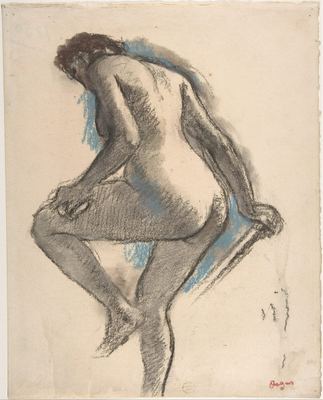
Bather Drying Herself, which appeared in the Degas and Lautrec drawings post, had a companion study. A woman seen from behind raises one knee and bends to sponge it. Her hair is dark brown, the outline of her body is drawn boldly in charcoal, and blue pastel is applied here and there around her body.
Degas built up his series by having the same model take various poses. The thick lines of the back and arms convey the weight of the body, and the blue pastel suggests a tub or a wall. Studies like these later grew into larger pastel works.
The dark hair, the charcoal outlines and the blue pastel pieces are your clues. Join the thick lines of the head and back first, place the blue pieces around the body, then fill in the blank paper. 24 or 48 pieces is about right.
What Sat Beside the Famous Works
All three works sat beside already famous series or masterpieces and were rarely mentioned. The media differ, from aquatint etching to lithograph to charcoal and pastel, but all three artists put as much care into the side branches as into the “main works.” Seen together with Goya’s other series, Los Caprichos, or Scenes Caught on Paper, they show more clearly how many directions painters came at a single subject from, again and again.
If you remember a series only by its one famous work, you miss things like these. Among the celebrated bullfight scenes was one in which the bullfighter is caught, beside the singer on stage was the little box that fed her lines, and behind the finished pastels were charcoal lines drawn over and over again.