Yvette Guilbert, Drawn Twice by Toulouse-Lautrec Four Years Apart
Published
Long black gloves, hair piled high, a thin body seen from the side. Henri de Toulouse-Lautrec drew the singer Yvette Guilbert again and again, and two of those prints are here. One appeared briefly in the post on drawings by Degas and Lautrec, the other in the post gathering pieces missing from their series, but the two have never been set side by side. Four years separate them. Across those four years, you can see plainly how much Lautrec’s hand changed while drawing the same person.
| Work | Year | Medium |
|---|---|---|
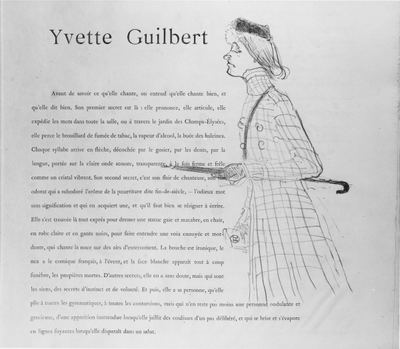
| Yvette Guilbert | 1894 | Lithograph, album title page |
| Frontispiece - Yvette Guilbert before the Prompter’s Box (London edition) | 1898 | Lithograph |
| Cover Design for “Les Vieilles Histoires” | 1893 | Hand-colored lithograph |
Paris, 1894: text and image on one page
 Solve this painting as a puzzle → about 5 minutes on Easy
In the 1894 Paris edition, French text fills most of the left side, and on the right a woman drawn in black line stands in profile. A few strokes capture the upswept hair, the long gloves and the long, close-fitting dress, and the title “Yvette Guilbert” sits large across the top. It is an album pairing an essay by the critic Gustave Geffroy with sixteen lithographs by Lautrec. Setting text and image on the same page was a fashionable approach in deluxe print albums of the time.
London, 1898: only a few lines
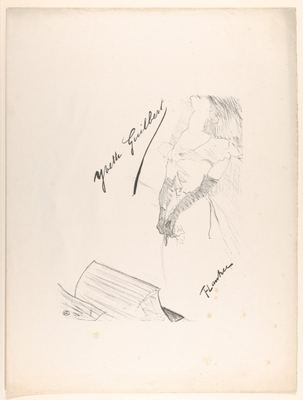
Four years later, the 1898 London edition is entirely different. A few black lines trace a woman’s profile on almost blank paper. The gloved arm, the upswept hair and the outline of the shoulder are all there is. In front, the prompter’s box set into the stage floor sits at an angle. The explanatory text is gone, and only enough line remains to recognize who she is.
Yvette Guilbert was a star of the Paris café-concert in the 1890s. Long black gloves, a thin figure and exaggerated expressions were her trademarks, and Lautrec drew her countless times. In 1894 he needed the help of text to introduce her. In 1898 he spared line after line and still made her recognizable at a glance. Put the two sheets side by side and you quickly see how much the artist’s hand pared away in four years before the same subject.
The composer leading a bear
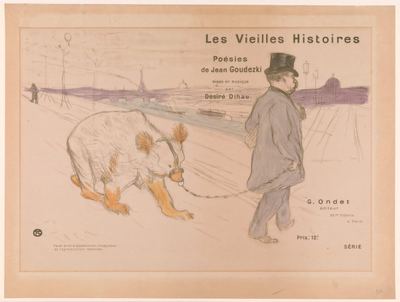
Yvette Guilbert does not appear in the cover for “Les Vieilles Histoires”, but someone from the same world does: a man walking along the banks of the Seine, leading a muzzled bear. It is a songbook of poems by Jean Goudezki set to music by Désiré Dihau. Lautrec took on the cover as Dihau’s friend, and the man leading the bear is said to be Dihau himself. It is a lithograph colored by hand in a few colors: yellow, green and purple. This small cover came up briefly at the end of the post on Goya’s bullfight prints, and it, too, carries traces of the network of Paris nightlife that revolved around cabarets and cafés-concerts.
Blank paper is the hardest
The 1894 edition divides into text pieces, figure pieces and blank-paper pieces. Fit the figure’s black lines and the title lettering first, sort the body text top to bottom by its line spacing, then fill in the blank pieces from the edges. The 48-piece setting is about right.
The 1898 edition is almost entirely blank paper, which puts it among the hardest puzzles on the whole site. Pick out every piece a line passes through and you will have only ten or so. The rest must be matched by the faint stains on the paper and the shapes of the pieces alone. The 24-piece setting is recommended, and the quickest route, such as it is, is to lay the shadowed pieces along the paper’s edges first and then fill the inside.
The “Les Vieilles Histoires” cover is no easy task either, with its wide margins and pale colors. Fit the brown of the bear, the man’s black clothes and the lettering pieces at the top first, then join the purple and green of the background using the bridge arches and the river’s horizon as guides.
Confidence in proportion to what was left out
Line the three up by year: in 1893, a light joke for a friend; in 1894, a star introduced with the help of text; in 1898, a portrait boiled down to a few lines. Drawing the same world, the same artist cut back on explanation year by year and gained confidence in his hand. Here was someone who could draw a single gloved arm on an empty sheet and trust that it would read as Yvette Guilbert. The empty space of the 1898 edition looks like the measure of that trust.