Half of a Pendant Reliquary Cross
One half of a bronze pendant cross engraved with the praying Virgin and saints: a small 11th-century Byzantine object that held relics and was worn around the neck. Full commentary ↓
Couldn't load the puzzle image.
Turn on piece outlines to see piece positions on this picture too
Drag the pieces into place · When zoomed in, drag an empty spot to move around
You can also play with a keyboard — Tab to the board, thenSpace pick a piece, Arrow keys move it (with Shift for small steps),Esc deselect, R rotate a piece (Shift+R the other way)
Half of a Pendant Reliquary Cross is a metal object by an unknown maker (11th century) in the collection of The Metropolitan Museum of Art. It measures 9.5 × 6 cm.
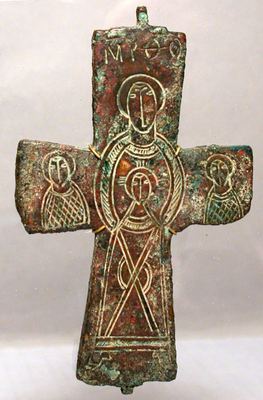
In the pictureA bronze cross, corroded with red and blue stains, bears figures engraved in line. At the center is the Virgin with both hands raised in prayer, on each arm is a half-length saint, and at the top letters are engraved. A loop is attached at the upper end, and it is less than 10 cm high.
BackgroundCrosses like this were made of two halves hinged together to form a hollow box, in which relics such as a fragment of a saint's bones or earth from the Holy Land were placed before it was hung around the neck. They were common objects carried by pilgrims and believers in the Byzantine Empire, and only one half of this one survives. The posture of the Virgin praying with open hands is a set formula in Byzantine art.
Puzzle tipThe shape of the cross is distinct, so if you lay out the background pieces first, the inside falls into place on its own. The red and green stains on the bronze differ from piece to piece and can be checked against the preview, and the engraved lines of the figures, though thin, are good clues to position. 24 or 48 pieces is a good fit.
- Culture
- Byzantine
- Classification
- Metalwork-Copper alloy
- Medium
- Copper alloy
- Dimensions
- 9.5 × 6 cm
- Credit line
- Bequest of Nanette B. Kelekian, 2020
Source: The Metropolitan Museum of Art ↗
Stories about this work
- A Story in the Palm of Your Hand: Three Medieval Ivories and Holy Objects
Most medieval art is small. Why it had to be, how to use zoom to read carvings on tiny surfaces while you assemble them, and advice on difficulty.