Landing at Newfoundland
The cable's end is hauled ashore on the Newfoundland coast as a crowd looks on, the final scene of the transatlantic telegraph. Full commentary ↓
Couldn't load the puzzle image.
Turn on piece outlines to see piece positions on this picture too
Drag the pieces into place · When zoomed in, drag an empty spot to move around
You can also play with a keyboard — Tab to the board, thenSpace pick a piece, Arrow keys move it (with Shift for small steps),Esc deselect, R rotate a piece (Shift+R the other way)
Landing at Newfoundland is an oil painting by Robert Charles Dudley (ca. 1866) in the collection of The Metropolitan Museum of Art. It measures 57.8 × 84.5 cm.
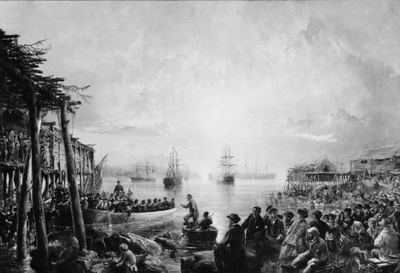
In the pictureA wooden pier and log posts stand on the shore, and people who have come off the boats carry the cable onto land. Crowds in hats line both sides, a few boats float on the sea, and the sky is bright and open. The museum's image is black and white.
BackgroundIn July 1866, the other end of the cable, which had set out from Ireland, arrived at a small harbor in Newfoundland, Canada. At that moment Europe and North America were connected by telegraph, and a few days later the first official messages were exchanged. Dudley painted the landing work on both the Irish side and the Newfoundland side, matching the beginning and the end of the series.
Puzzle tipIt is black and white, but the crowds of figures, the straight lines of the pier and the bright expanse of sky are distinct. Fit the vertical pieces of the log posts on the left and the crowd pieces on the right first, and use the small silhouettes of the boats on the sea to anchor the middle. Fill in the sky pieces last. 48 pieces is about right.
- Artist
- British, 1826–1909
- Classification
- Paintings
- Medium
- Oil on canvas
- Dimensions
- 57.8 x 84.5 cm
- Credit line
- Gift of Cyrus W. Field, 1892
Source: The Metropolitan Museum of Art ↗
In these collections: Sea and Waterside Masterpiece Puzzles
Stories about this work
- Dudley's Six Paintings of the 1866 Atlantic Cable, Made Aboard Ship
In 1866 the largest ship in the world laid a telegraph cable across the Atlantic. We read, in order, the six paintings left by an artist who sailed on the voyage.