Dudley's Six Paintings of the 1866 Atlantic Cable, Made Aboard Ship
Published
Under the moonlight, a ship lowers lines into the sea. It is groping with grappling hooks for a telegraph cable that has sunk to the bottom of the Atlantic. This is a scene from Robert Charles Dudley’s series on the transatlantic cable, and these six paintings contain no saints, no kings and no myths. The protagonists are a thick cable and the people who handle it. The series belongs to the European Paintings department, but it does not feel much like museum painting.
All six are oil on canvas, and the museum’s records date them to around 1866. Dudley is said to have sailed on this voyage himself as its artist. So these are less imagined pictures than a record of what he saw on the spot.
The cable that broke in 1865
There had been attempts to lay a telegraph cable across the Atlantic before 1866. In 1865 the cable snapped in the middle of the Atlantic and sank to the seabed. The following year, 1866, the Great Eastern set out again and succeeded in laying the cable, and while it was at it, it also hauled up the broken cable and completed a second line.
Why this mattered is clear from the speed. In an age when news between Europe and North America took about ten days by ship, the telegraph cut that time to a few minutes. Photographs were not yet common, so pictures would have been needed to spread news of such an event widely, and that is probably why an artist was taken aboard. Who brought Dudley on board, and under what arrangement, cannot be determined from the material available now.
From the Irish coast to the voyage home
Arranged in the order of events, the series tells a single story. The sequence below is built from what can be read in the paintings’ titles.
| Order | Work | Scene |
|---|---|---|
| 1 | Landing the Shore End of the Atlantic Cable | Hauling the end of the cable ashore on the Irish coast |
| 2 | Making the Splice between the Shore End and the Ocean Cable | Joining two kinds of cable on deck |
| 3 | Awaiting the Reply | Waiting in a cabin for a signal from the other side |
| 4 | Grappling for the Lost Cable | Hooking the sunken cable on a moonlit night |
| 5 | Landing at Newfoundland | Bringing the cable ashore on the opposite coast |
| 6 | Homeward Bound: “The Great Eastern” | The ship, its task done, anchored in harbor |
This is only one interpretation. When the splicing took place on the actual voyage, and exactly when the lost cable was recovered, have not been rigorously confirmed in chronological order. Still, the broad outline, starting from the departure coast, passing the opposite coast and ending with the voyage home, is clear from the titles alone.
Splices and signals: scenes of technical work
The series looks less at the climax of events than at the process of the work itself.
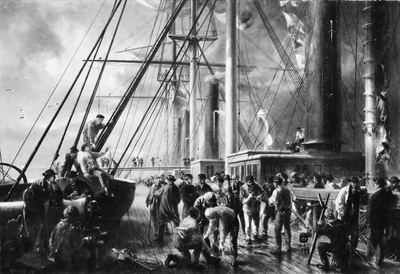
Near the shore a thick, sturdy cable was used, and in the deep sea a thinner, longer one. So a separate job was needed to join the two.
 Solve this painting as a puzzle → about 5 minutes on Easy
Making the Splice between the Shore End and the Ocean Cable shows that moment.
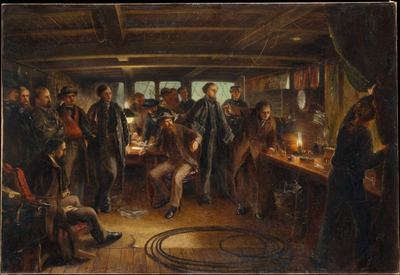
In Awaiting the Reply, everyone in the cabin is looking at one spot. A signal from the other side would mean the cable is alive. Everyone on board is waiting for that one signal.
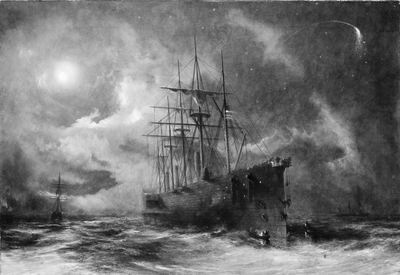
Grappling for the Lost Cable sits at the heart of a dramatic event, yet the picture is quiet. Moonlight, a single ship, the lines. That is all.
These paintings part ways with traditional history painting in that the great ship and the thick cable do not stay in supporting roles but become the main subjects. You could read them as an early example of making the achievements of the industrial age the subject of painting.
Four in black and white, two in color
All six can be assembled as puzzles. Since they are a series by one artist, it is enjoyable to compare them as you go.
The first thing you notice is that pictures with and without color are mixed together. Among the museum’s images, Grappling for the Lost Cable, Landing at Newfoundland, Homeward Bound: “The Great Eastern” and Making the Splice between the Shore End and the Ocean Cable are in black and white. They are good practice for solving with only light, dark and line, and the strategy for pictures with large areas of a single color applies directly. All six also share wide expanses of sky and sea. Homeward Bound: “The Great Eastern” in particular, with sky and water spread wide over a calm harbor, is easy to get stuck on. Build the framework first from the straight lines of the masts and the dark pieces of the hull, and fill in the sky last, watching the differences in brightness among the clouds.
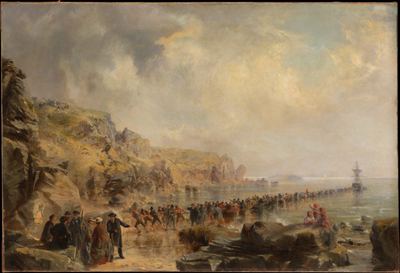
In Landing the Shore End of the Atlantic Cable, the diagonal of people lined up on the beach carrying the cable splits the picture in two. Finish this diagonal first, and the sky above and the cliffs below separate on their own.
If this is your first time, I recommend starting with one of the color paintings, Awaiting the Reply or Landing the Shore End of the Atlantic Cable, and moving on to the black-and-white ones once you have the feel of it. 48 pieces suits them, and the large Homeward Bound: “The Great Eastern” is worth trying at 100 pieces too. For how to raise the piece count, see the guide to taking on large puzzles.
Neither landscape nor history painting
Ships and sea make you want to look at these with the eye of how to choose landscape puzzles, but then you miss half of this series. These were not painted to show scenery. They are closer to the pictures of a witness who watched the moments as the work happened.
Before a single line of cable could be laid kilometers beneath the sea, the people in these pictures stayed up through the night on deck, threw grappling hooks and waited for signals. If each picture holds on to that waiting, then the time spent fitting the pieces together one by one may bring you just a little closer to it.