Madame X (Virginie Amélie Avegno Gautreau)
A woman in a black dress turns her head to show her profile: the portrait that scandalized the Paris Salon and sent John Singer Sargent off to London. Full commentary ↓
Couldn't load the puzzle image.
Turn on piece outlines to see piece positions on this picture too
Drag the pieces into place · When zoomed in, drag an empty spot to move around
You can also play with a keyboard — Tab to the board, thenSpace pick a piece, Arrow keys move it (with Shift for small steps),Esc deselect, R rotate a piece (Shift+R the other way)
Madame X (Virginie Amélie Avegno Gautreau) is an oil painting by John Singer Sargent (1883–84) in the collection of The Metropolitan Museum of Art. It measures 208.6 × 109.9 cm.
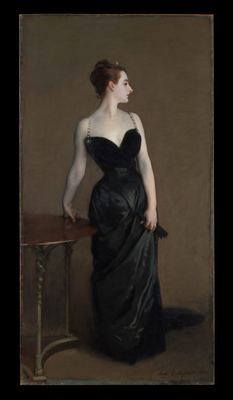
In the pictureAgainst a brown background stands a woman in a black satin dress. One hand rests on a table and the other lightly gathers her skirt; her face is turned to the side, so only her pale profile and the line of her neck are visible. The dress's shoulder straps are made of jewels, and her skin is white as if powdered. Most of the picture is dark, and only the figure's skin glows.
BackgroundThe model was Virginie Gautreau, an American in Paris society. Sargent showed this portrait at the Paris Salon of 1884, where it caused a great scandal. In the original painting the right shoulder strap had slipped down, and a flood of criticism called it far too provocative by the standards of the day. Sargent repainted the strap in a raised position and eventually left Paris for London. Thirty years later, when he sold the painting to the museum, he called it "the best thing I have done," and to conceal the model's name he had it called Madame X.
Puzzle tipAs a puzzle it is three masses: flesh, black, and brown. Join the light pieces of the face, neck, and arms first, then divide the black pieces of the dress by the direction of the satin's sheen and the background by shades of brown. It is on the difficult side, so at 100 pieces or more it is best to keep the preview on.
- Artist
- American, Florence 1856–1925 London
- Culture
- American
- Medium
- Oil on canvas
- Dimensions
- 208.6 × 109.9 cm
- Credit line
- Arthur Hoppock Hearn Fund, 1916
Source: The Metropolitan Museum of Art ↗
In these collections: Masterpieces Everyone Knows
Stories about this work
- From Washington Crossing the Delaware to Madame X: Six American Paintings as Puzzles
A 3-meter panorama shown for an admission fee, a history painting full of errors, a portrait that scandalized the Salon. Six works by 19th-century American painters who helped shape the nation's image, and why big paintings are actually easier as puzzles.
- 12 Must-See Paintings at the Met in New York, Meet Them First as Puzzles
Washington Crossing the Delaware, Madame X, Bruegel's Harvesters, Vermeer and Rembrandt, Van Gogh's wheat field and Hokusai's wave. Twelve must-see paintings at the Met, how to check whether they are on view, and how to preview them as puzzles.