From Washington Crossing the Delaware to Madame X: Six American Paintings as Puzzles
Published
American painters of the 19th century had a problem their European counterparts did not. The country did not yet have a face. Its history was short, and the West was land most people in the East had never seen. That is part of why American paintings from this period are so large, hold so much, and say so openly, “This is our country.” Here are six works at the Metropolitan Museum of Art, in order of date: four landscapes, one history painting, and one portrait that caused a scandal in Paris.
| Work | Artist | Year | Size |
|---|---|---|---|
| The Oxbow | Thomas Cole | 1836 | 1.9 m wide |
| Washington Crossing the Delaware | Emanuel Leutze | 1851 | 6.5 m wide |
| Heart of the Andes | Frederic Edwin Church | 1859 | 3 m wide |
| The Rocky Mountains, Lander’s Peak | Albert Bierstadt | 1863 | 3 m wide |
| Madame X | John Singer Sargent | 1883–84 | 2.1 m tall |
| The Gulf Stream | Winslow Homer | 1899 | 1.2 m wide |
A Mountain Clearing After a Storm and a Bending River: Cole’s Oxbow
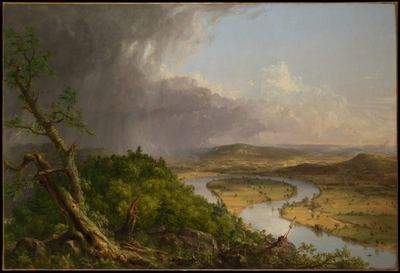 Solve this painting as a puzzle → about 5 minutes on Easy
View from Mount Holyoke, Northampton, Massachusetts, after a Thunderstorm—The Oxbow is split down the middle. On the left are a dark mountain with a passing storm and a broken tree; on the right, the Connecticut River winds in sunlight past neat farmland. The name comes from the river’s U-shaped bend, like an ox yoke (an oxbow). On a rock at lower left, a painter at a small easel turns to look back at us. It is Cole himself.
Cole was the man who founded the American school of landscape painting known as the Hudson River School. The reading of this picture as a single American moment, where wilderness (left) meets civilization (right), has become the accepted one. Many people read in the broken tree Cole’s regret for nature disappearing in the face of development.
A National Picture Full of Mistakes: Leutze’s Washington
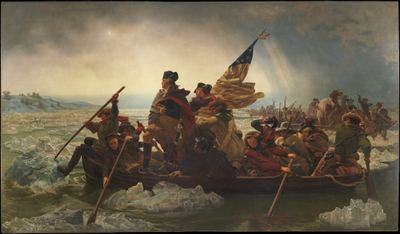
In Washington Crossing the Delaware, a cramped boat pushes across a dark blue river with chunks of ice floating in it. Among twelve soldiers, George Washington stands alone and upright, looking toward the far bank. It is the surprise attack on Trenton on Christmas night, 1776. Look closely and not much is right. The actual crossing happened in the dead of night, that Stars and Stripes had not even been made yet, and standing in a boat like that would capsize it. The painter, Leutze, was an American artist working in Germany, and he finished it in Düsseldorf in 1851. Even so, this is the picture Americans see when they think of the moment the nation was born. It is also the most parodied of all American paintings.
Paintings Shown for an Admission Fee: Church and Bierstadt
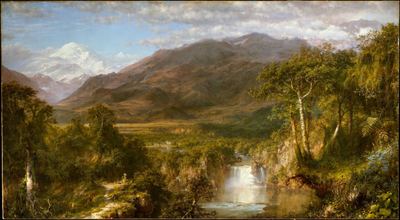
Heart of the Andes is a panorama that packs all of the Andes into one canvas. Below the snow-covered peak of Chimborazo are a misty valley and a waterfall, and among tropical trees and flowers two small figures kneel before a cross. Up close, every leaf and every bird is painted; step back a few paces and you see a whole continent. Church finished the painting in New York in 1859 from sketches gathered on two trips to South America. Then he hung it by itself in a darkened room and charged admission. Twelve thousand people came in three weeks, and visitors studied the details through opera glasses.
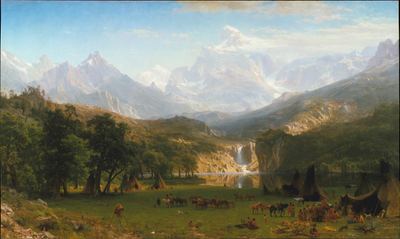
The Rocky Mountains, Lander’s Peak was exhibited almost as a challenge to Church’s picture. The upper half shows snow-covered peaks breaking through clouds into the light; the lower half shows a green meadow, a lake, and a Native American encampment with tents. Bierstadt went into the Rockies in 1859 with a Western survey expedition and gathered sketches and photographs, then finished the painting in his New York studio in 1863. The mountains are far higher and steeper than the real ones. The painting became an image that encouraged westward railroads and settlement, while the Native people in the picture were driven off that land a few years later.
The Portrait That Sent Its Painter to London: Sargent’s Madame X
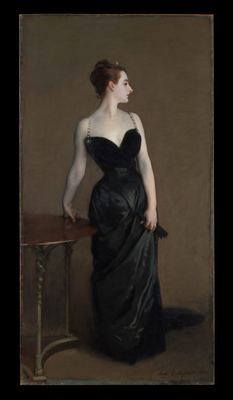
The woman in Madame X wears a black satin dress, rests one hand on a table, and turns her face to the side. All we see is a pale profile and the line of her neck. The sitter was Virginie Gautreau, an American in Parisian society. When Sargent sent the painting to the Paris Salon in 1884, the right shoulder strap was shown slipping down, and critics attacked it as too provocative. Sargent repainted the strap in place but in the end left Paris for London. Thirty years later, when he handed the painting over to the museum, he called it “the best thing I have done” and asked that it be called Madame X so the sitter’s name would not be revealed.
A Sailor Lying Among Sharks: Homer’s Gulf Stream
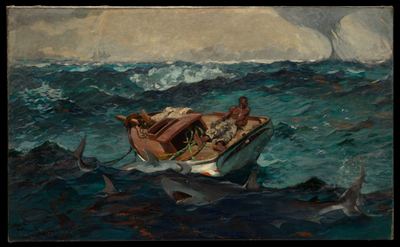
The small boat in The Gulf Stream has a broken mast and no rudder. A Black sailor lies on it, propped on one elbow, while sharks circle the boat, cutting through reddish water. A waterspout rises on the horizon at right. Far off to the left a sailing ship passes, but the sailor does not look its way. Homer painted it in 1899 after trips to the Bahamas and Florida. When people said it was too hopeless, Homer is said to have replied curtly that the sailor would be rescued in the end.
Why a 3-Meter Painting Is Easier as a Puzzle
The originals by Church, Bierstadt and Leutze run 3 to 6 meters. Yet paintings like these are actually easier as puzzles. There is so much detail that even cut into 300 pieces, every piece holds something different, and there are more clues than chances to get confused. Split Heart of the Andes into four layers, sky, mountains, valley and foreground forest, and finish one layer at a time. The waterfall, the cross, and the tree carved with the signature are your reference points. Zooming in as you work, you end up doing exactly what visitors of that era did with opera glasses. If you are trying a 300-piece challenge for the first time, this is a good painting to start with.
For Leutze’s painting, place Washington and the flag first, then fill in the figures in the boat one at a time. The river falls into place by the positions of the white ice chunks, and the sky by its shading, which deepens from bright yellow at the bottom to dark gray at the top. For Bierstadt, first divide the pieces into top (mountains and sky) and bottom (meadow and encampment). Among the white pieces at the top, start by joining the ones along the rocky ridges of the peaks, the pieces a dark line runs through, to build the shape of the mountains, then fill in between.
The Oxbow is divided left and right into dark and light, so sort the pieces that way first. On the left, look at the shapes of trees and rocks; on the right, look at the bends of the river and the grid of the fields. The easel and the umbrella are small but reliable guides. The “sky last” advice from the landscape puzzle guide changes a little for this painting. It works better to start with the pieces along the boundary where the dark storm clouds on the left meet the clear sky on the right.
The two smaller works are the ones that give more trouble. Madame X is just three masses, flesh, black and brown, so join the light pieces of the face, neck and arms first, and split the black pieces of the dress by the direction in which the satin catches the light. At 100 pieces or more, keep the preview on. The Gulf Stream has a lot of sea pieces, with blue, green and red tones mixed together. Finish the boat, the figure and the sharks first, then divide the sea into pieces with white wave foam and pieces without. The sky is bright on the left and dark toward the storm on the right, so use brightness to fix horizontal position.
For a series painted at sea in the same era, there are Dudley’s six Atlantic cable paintings. And the Metropolitan Museum of Art, which owns these six works, itself started out in a small building on 14th Street. Paintings made to give a nation a face now serve as the face of that museum.
Frequently asked questions
Is Washington Crossing the Delaware historically accurate?
It gets a lot wrong. The real crossing took place in the dead of night, the Stars and Stripes in the picture had not yet been made, and anyone standing in a boat like that would tip it over. Leutze, who worked in Germany, finished it in Düsseldorf in 1851, yet it became the picture Americans see when they think of the nation's birth.
Is a 3-meter painting harder as a puzzle?
It is actually easier. The detail is close to endless, so even at 300 pieces every piece holds something different, which means plenty of clues. Split Heart of the Andes into four layers, sky, mountains, valley and foreground forest, and finish one layer at a time.
Why did Madame X cause a scandal in Paris?
When it was shown at the 1884 Salon, the right shoulder strap was originally slipping down, and critics attacked it as too provocative. Sargent repainted the strap in place and eventually left Paris for London, and he asked that the painting be called Madame X to keep the sitter's name hidden.