Madonna and Child with Saints Mary Magdalen and Sebastian
It looks 15th-century but is an early 20th-century forgery: a Madonna and Child by the Sienese painter Icilio Federico Ioni, imitating old pictures. Full commentary ↓
Couldn't load the puzzle image.
Turn on piece outlines to see piece positions on this picture too
Drag the pieces into place · When zoomed in, drag an empty spot to move around
You can also play with a keyboard — Tab to the board, thenSpace pick a piece, Arrow keys move it (with Shift for small steps),Esc deselect, R rotate a piece (Shift+R the other way)
Madonna and Child with Saints Mary Magdalen and Sebastian is a tempera and gold painting by Icilio Federico Ioni (15th century style, made in the late 19th to early 20th century) in the collection of The Metropolitan Museum of Art. It measures 109.5 × 72.4 cm.
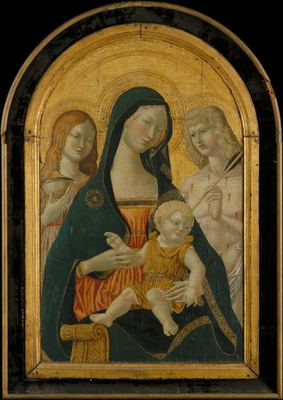
In the pictureInside a gilded arch, Mary in a blue mantle holds the Child, with the fair-haired Mary Magdalen on the left and Sebastian holding an arrow on the right. The Child, half-clothed, reaches out his hand, and the halo behind Mary is tooled with a dot pattern. The gold has scratches and cracks like an old painting.
BackgroundThis painting is in the 15th-century Sienese style, but it was actually painted in the late 19th or early 20th century by Icilio Federico Ioni, who was born in 1866. Ioni reproduced the materials and techniques of old panel paintings, even the marks of age, and sold them to collectors, and he later revealed this in his autobiography. The museum holds this painting not as a forgery but as an example of "the craft of imitating old paintings." There is no better teaching tool for training the eye to spot forgeries.
Puzzle tipIt divides by color exactly like a genuine old painting: blue mantle, flesh tones, fair hair and gold background. Fit the three faces and the Child first, lay the curved pieces of the arch around the top, then fill in the gold. Solving it at 300 pieces, it is also fun to notice how convincing the pattern of cracked gold is.
- Artist
- Italian, Siena 1866–1946 Siena
- Classification
- Paintings
- Medium
- Tempera on wood, gold ground
- Dimensions
- 109.5 × 72.4 cm
- Credit line
- Robert Lehman Collection, 1975
Source: The Metropolitan Museum of Art ↗
Stories about this work
- A Madonna and Child Pretending to Be 500 Years Old: A Painting Made in an Old Style
One of the Madonna and Child paintings on this site is not a 15th-century work. It was painted much later to look like one, and the museum does not hide that fact.
- Why Are There So Many Madonna and Child Paintings? Painting the Same Scene for Centuries
This site alone has 12 paintings of the Madonna and Child. Why the same scene was repeated for centuries, and how to find the differences within it.
Puzzles to try next
More Robert Lehman Collection puzzles· Stories and puzzle tips