Why Are There So Many Madonna and Child Paintings? Painting the Same Scene for Centuries
Published · updated
Madonna and Child, Madonna and Child, and again Madonna and Child. Browse the Robert Lehman Collection and the same title keeps coming back. There are twelve wooden panel paintings centered on the Virgin and the Christ Child alone. Count the boxwood Statuette of the Virgin and Child and it comes to thirteen.
Painters worked on commission
Medieval and early Renaissance painters were less people who painted what they wanted than craftsmen who took commissions and delivered the work. When a church, a monastery or a wealthy family ordered a painting, the contract spelled out the size, the materials and even the figures to be included.
The most common commission was the Madonna and Child. It served as a small altarpiece for private prayer, as a large church altarpiece and as a small piece kept at home. With overwhelming demand, the same scene was bound to be repeated.
You can tell the use from the size. Bernardo Daddi’s Madonna and Child Enthroned is less than 10 centimeters wide. It is the central panel of a three-part altarpiece that was opened for prayer while traveling or in one’s room. The Madonna and Child Enthroned by a painter from the Marche region is 1.4 meters tall and appears to have occupied the center of a large altarpiece, together with panels of various saints. The same subject spans sizes from the palm of a hand to 1.4 meters.
The same frame, different choices
That does not mean painters turned out identical pictures. Even within a fixed frame, each made their own choices.
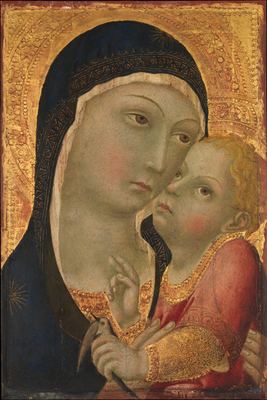
The child’s pose differs first. Whether he faces forward, looks up at his mother or twists his body changes the character of the painting entirely. In Sano di Pietro’s Madonna and Child, the child grips his mother’s white veil with one hand and presses his cheek to hers. This cheek-to-cheek type came from Byzantine icons. In Bellini’s Madonna and Child, the child stands on a stone parapet and raises his right hand in blessing. The later the period, the more the child generally moves like a real baby.
The mother’s gaze also divides them. In some works the Virgin looks out at us beyond the picture; in others she looks down only at her child. In the first, the dignity befitting an object of faith comes forward; in the second, the feeling of a mother. The Botticelli workshop’s Madonna Adoring the Child is the far end of the second kind. The kneeling Mary looks down, hands joined, at the child lying on the grass.
Where she sits has meaning too. A throne speaks of her dignity as Queen of Heaven. Mary seated on the ground, as in Bartolomeo Vivarini’s altarpiece The Madonna of Humility, the Annunciation, the Nativity, and the Pietà, signifies humility, a type that spread widely in the 14th and 15th centuries. The enthroned type is covered separately in the Madonna enthroned, and small symbols such as the pomegranate the child holds in reading the symbols in Florentine Madonnas.
Who stands beside her also makes a difference.
 Solve this painting as a puzzle → about 5 minutes on Easy
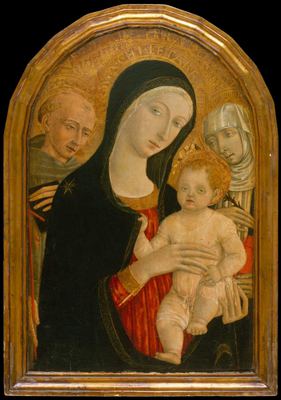
When saints appear alongside, as in Madonna and Child with Saints Francis and Catherine of Siena, they are usually figures the patron especially venerated. The patron’s taste and faith have gone into the painting. Catherine was declared a saint in 1461, and this panel was painted around 1476–80, at a time when painters in her home city of Siena were vying to paint the new saint. In Lorenzo Veneziano’s Madonna and Child Enthroned with Two Donors, the small couple kneeling at the foot of the throne are the patrons themselves. It was customary to paint them much smaller than the Virgin.
Assembling two in a row
Assembling several works on the same subject is quite a good way to look at them. Finish one Madonna and Child and then solve another right after, and paintings that all looked alike at first start to look noticeably different.
A good pair is the Madonna and Child by Sano di Pietro and the one by Bellini. The first divides into four colors, blue mantle, red dress, flesh tone and gold leaf, which makes it a good one to solve first. The second has many color areas, with sky and landscape, parapet and garland, so even 300 pieces is manageable. Among painters from the same city of Siena, Sano di Pietro used long, soft facial contours, while Matteo di Giovanni used distinct outlines and solid forms. When you fit the face pieces, your fingertips catch this difference first.
It adds one more comparison to the idea that puzzles make you look at a painting longer. Looking at one painting alone, you cannot see the convention. Looking at several, you see both the convention and the places where painters departed from it.
Gold grounds, and one that pretends to be old
Most of these paintings are panel paintings on a gold-leaf ground. Eight of the twelve list a gold ground among their materials. Why the background is gold, and how that affects puzzle difficulty, is covered in that post. One of the eight is not a 15th-century painting. The Madonna and Child with Saints Mary Magdalen and Sebastian, with the two saints standing at her sides, was painted in the old style in the late 19th to early 20th century. Its story is in a Madonna and Child pretending to be 500 years old.
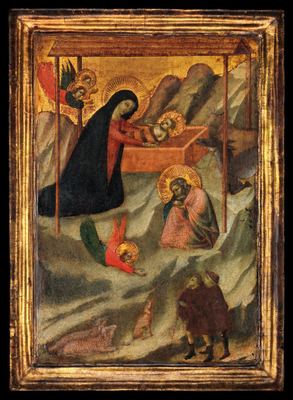
There is also a painting where the Madonna and Child widens into a narrative scene. In The Nativity, Mary does not hold the child but bends to look down at him lying in the manger. Below are Joseph, seated with his chin in his hand, and a flock of sheep. Building space by stacking gray rocky mountains in layers was the method of Florentine painters before perspective arrived. In masterpiece puzzles to solve at Christmas, which groups puzzles in the order of the Christmas story, you can see this painting side by side with other Nativity scenes.
Though the same scene was repeated for centuries, no two of these twelve paintings are alike. Because there was a fixed frame, the small differences each painter introduced remain all the more distinct.
Frequently asked questions
Why are there so many Madonna and Child paintings?
Medieval and early Renaissance painters were closer to craftsmen who took commissions and delivered work, and the Madonna and Child was the most frequently commissioned subject, for private devotion, church altarpieces and small pieces for the home.
They are all the Madonna and Child. What is different about them?
The child's pose, the Virgin's gaze, where she sits and the saints painted with her differ from painting to painting. When the Virgin looks at the viewer, her dignity as an object of faith is emphasized; when she looks down only at the child, her feeling as a mother comes forward.
Which pair is good for comparing Madonna and Child paintings as puzzles?
The Madonna and Child paintings by Sano di Pietro and Bellini. The first divides into four colors, blue mantle, red dress, flesh tone and gold leaf, which makes it a good one to solve first; the second includes sky and landscape.