Why Egyptian Statues Step Forward on the Left Foot: Rules of Pose Kept for 3,000 Years
Published
Every standing man puts his left foot forward, and every seated king rests both hands on his knees. Leaf through the 39 works of Egyptian art one after another and you see this repeated. Works made hundreds of years apart resemble one another as if they came from a single workshop.
You are not imagining it. Egyptian sculpture had conventions about pose. Once you know them, the statues read much more easily, and the puzzle pieces start to look different too.
The standing man steps out on his left foot
 Solve this painting as a puzzle → about 5 minutes on Easy
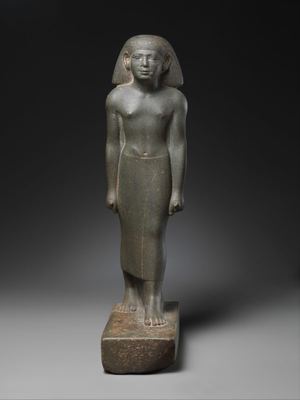
Statuette of a striding man is a small stone sculpture about 32 centimeters tall. A man wearing a shoulder-length wig, bare-chested and wrapped in a long kilt, steps forward on his left foot with both arms held against his body.
This pose was the basic type for the Egyptian standing male figure. It is said to have been used almost unchanged for nearly 3,000 years, from the Old Kingdom to the Roman period. It is also often said that the kouros (standing statue of a young man) of early Greek sculpture was influenced by it.
Look closely, though, and it is not the capture of a moment in mid-stride. The heels are on the ground, and the body neither leans back nor tips forward. It is closer to a state of pause just before stepping out, “a figure ready to walk forward forever,” so to speak. Why it was the left foot in particular has not been clearly established.
The seated king keeps his hands on his knees
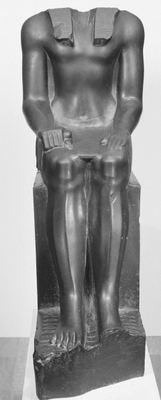
Seated Statue of King Senwosret I is a seated statue of a king whose head is lost, leaving only the body. The broad shoulders, the two hands placed on the knees and the body facing forward are upright and orderly. It stands more than a meter tall, and the dark stone surface is polished smooth.
The conventions of the seated statue are clear too. It faces forward, it is symmetrical left to right, and the hands are on the knees. There is no twisting of the body or turning of the gaze to the side.
With no head, how do we know whose statue it is? The hieroglyphs carved on the top and sides of the kilt tell us. In Egyptian sculpture, what determined who a figure was lay in the written name more than the features of the face, and a statue was closer to a vessel for preserving that name forever.
The Osiride figure, wrapped like a mummy
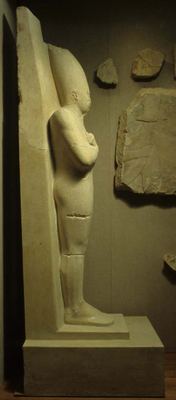
It is the same king, yet Osiride statue of Senwosret I has an entirely different feel. It is a standing figure of white limestone, 1.8 meters tall, with the body wrapped in cloth like a mummy and both arms crossed in front of the chest. On the head is a tall crown, and the back is attached to a pillar behind.
This is an Osiride figure. It overlays on the king the form of Osiris, god of death and rebirth, carrying the meaning that the king would live again even after death. In the pyramid temple of Senwosret I, figures like this are said to have stood in rows at every pillar, and the Metropolitan Museum of Art’s excavation team brought some of them back in the early 20th century. Today it is bare white stone, but it is thought to have been painted when it stood in the temple.
The king in the seated statue has a strong, young body, and the king in this statue has a body wrapped like a mummy. By changing pose, one king took on both roles: the living king and the king reborn.
A face that broke the convention: Senwosret III
Because the conventions were so strong, exceptions stand out at once.
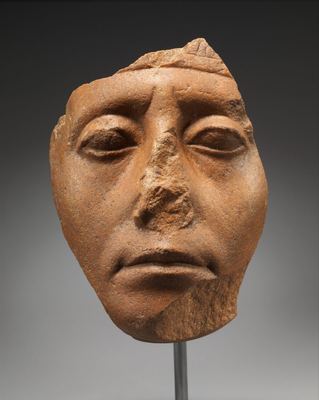
Face of Senwosret III is a sculpted face of red quartzite, a little over 16 centimeters. The eyelids hang heavy, deep furrows run between nose and mouth, and the corners of the mouth droop.
Egyptian sculpture usually portrayed the king as eternally young and perfect. This king of the 19th century B.C. alone was left with a weary, troubled face. Interpretations differ on whether it reproduces his actual face or inscribes the ideal of “the king who worries for his people.” Either way, placed beside the two previous statues, it shows that even when pose followed the rules, the face could change with the times.
Eighteen squares from the soles of the feet to the hairline
The rules were not only about pose. They covered the proportions of the body as well. Egyptian artists are known to have used grids for the preparatory drawings of paintings and sculpture. A standing figure was divided from the soles of the feet to the hairline into a fixed number of squares (said to be 18 in the Old and Middle Kingdoms), and it was set out in which square the shoulders, knees and elbows would fall.
Dividing a picture into a grid and filling it in square by square is curiously similar to a puzzle. This is only the generally known explanation, however, and no traces of a grid are directly visible on the works introduced here.
Hints a fixed pose gives you in a puzzle
A fixed pose means you can guess the outline in advance when doing the puzzle. Standing statues are tall and narrow, so the arrangement of pieces narrows accordingly. It is easiest to start with distinctive pieces like the face, the wig and the base, and then fill in the body between them. Seated statues are symmetrical, so once you find the left knee piece, the right knee falls at the same height. Fit one side and the place for the other side shows itself.
With dark stone, the deep-toned pieces of the body are hard to tell apart. In that case, use as reference the bright lines where light reflects off the knees, arms and folds of the kilt. If the background is even, frame the edges first and work inward, following the strategy for pictures with large areas of a single color. Very tall pictures produce thin pieces, so I recommend starting at 48 pieces rather than 24. Tips that apply to Egyptian works in general are in a separate post, the Egyptian stone statue puzzle guide.
The same rules, different hands
Not a single name survives of the people who made these sculptures. As discussed in what “anonymous” means, Egyptian sculptors were probably judged less by name than by how well they kept the conventions. Though they repeated the same poses for 3,000 years, each stone shows a different touch. It may have been a contest of very small differences played out within the rules.
As you assemble the puzzle, those small differences show in every piece.