Relief block with the names of Amenemhat I and Senwosret I
A limestone block carved with the names of Amenemhat I and his son Senwosret I, from the pyramid temple of Amenemhat I at Lisht North. Full commentary ↓
Couldn't load the puzzle image.
Turn on piece outlines to see piece positions on this picture too
Drag the pieces into place · When zoomed in, drag an empty spot to move around
You can also play with a keyboard — Tab to the board, thenSpace pick a piece, Arrow keys move it (with Shift for small steps),Esc deselect, R rotate a piece (Shift+R the other way)
Relief block with the names of Amenemhat I and Senwosret I is a stone object by an unknown maker (ca. 1962–1952 B.C.) in the collection of The Metropolitan Museum of Art.
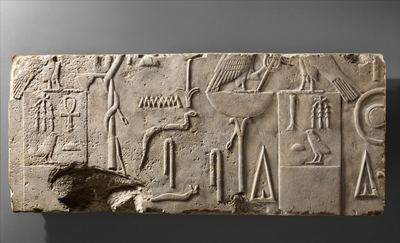
In the pictureLarge hieroglyphs are carved in raised relief on a grayish-white limestone block 88cm wide and 37.5cm high. There is a rectangular frame on each side, and above each frame the feet and tail of a bird remain, cut off at the top edge of the block. Inside the frames are an ankh, a sign hanging down in three strands, and a small bird. In the middle are a vulture perched on a basket atop a flower stalk, a water sign, and a twisting snake, and lower down a pointed triangular sign appears twice. The surface is pitted with many small holes, and a large piece is gouged out at the lower left.
BackgroundThe stone was found when the museum excavated the pyramid temple of Amenemhat I at Lisht North in 1908–09. The frames on either side appear to be serekhs, which held the king's Horus name, and the names of Amenemhat I, founder of Dynasty 12, and his son Senwosret I appear together on one stone. It is cited as evidence for a coregency, the theory that the aging king made his son co-ruler in advance, but even the museum's record gives the date with a question mark: "reign of Amenemhat I (coregency with Senwosret I?)." Lisht was a royal burial ground near Itjtawy, the new capital founded by Dynasty 12.
Puzzle tipThe signs are large and clearly shaped, so each one is a reference point. Place the rectangular frames on either side with the bird feet above them, and the large basket and vulture in the middle, then fill the gaps with the ankh, water, snake, and triangle signs. The gouged area at the lower left is deeply shadowed and easy to find. Run the dark gray background above and below along the straight outline of the block. The shadows of the raised relief all fall to the same side, so the light and dark edges of each sign let you check which way a piece faces. 48 pieces is a good fit.
- Period
- Middle Kingdom
- Dynasty
- Dynasty 12
- Medium
- Limestone
- Dimensions
- H. 37.5 cm (14 3/4 in.); W. 88 cm (34 5/8 in.); D. 13 cm (5
- Credit line
- Rogers Fund, 1909
Source: The Metropolitan Museum of Art ↗
Stories about this work
- Five Stones from the Ruined Temple of Amenemhat I
The pyramid temple of the king who founded the 12th Dynasty has collapsed, but its excavated fragments still record his name, his face, and his co-rule with his son.