Self-Portrait
Against a dark brown background, Rembrandt at 53, wearing a beret, gazes out at us: a key late self-portrait painted after his bankruptcy. Full commentary ↓
Couldn't load the puzzle image.
Turn on piece outlines to see piece positions on this picture too
Drag the pieces into place · When zoomed in, drag an empty spot to move around
You can also play with a keyboard — Tab to the board, thenSpace pick a piece, Arrow keys move it (with Shift for small steps),Esc deselect, R rotate a piece (Shift+R the other way)
Self-Portrait is an oil painting by Rembrandt (1659) in the collection of National Gallery of Art. It measures 84.5 × 66 cm.
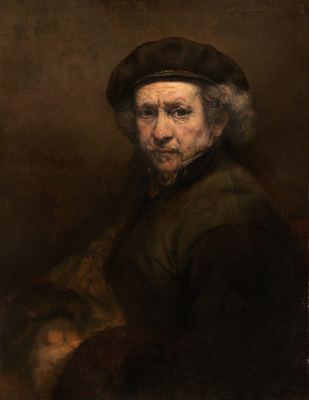
In the pictureAn old man, seen to just above the waist, turns his body to the left and only his face toward us. Gray curls cover his ears beneath a dark brown beret edged in gold, and deep lines mark his furrowed brow and the corners of his eyes. The tip of his nose is reddish, and a thin gray mustache and beard frame his mouth. Light enters from the upper left and brightens only the face, while the brown coat with its raised collar and the background on the right sink into darkness. At lower left his clasped hands are faintly visible in shadow, and a signature and date are written in the background at left center.
BackgroundRembrandt painted it in Amsterdam in 1659, at the age of fifty-three. Once the most successful portrait painter of the city, he could not cope with his debts and had to dispose of his house and collection in the late 1650s; this painting was made after that. He painted his own face throughout his life from his youth, and in the late self-portraits he shows himself growing old without embellishment. The painting passed through the families of the Dukes of Montagu and Buccleuch in England from the 18th century, was bought by Andrew Mellon in 1929, and entered the National Gallery of Art in Washington in 1937.
Puzzle tipMost of the picture is brown and black, so it counts as a dark painting. Fit the lit face and gray hair first, then join the top line of the head with the gold edge of the beret. Next come the signature at left center and the area around the hands at lower left. The background is a slightly lighter yellowish brown at upper left and grows black toward the right and bottom, so lay out the pieces in order of brightness and fill from top to bottom. With so many dark pieces, 48 pieces work well.
- Classification
- Painting
- Medium
- Oil on canvas
- Dimensions
- 84.5 × 66 cm
- Credit line
- National Gallery of Art, 1937.1.72
Source: National Gallery of Art ↗
In these collections: Portrait and Self-Portrait Puzzles