Self-portrait as the Apostle Paul
An aged Rembrandt, a white cloth wound around his head, looks out as the apostle Paul holding a manuscript. A signature self-portrait of his late years. Full commentary ↓
Couldn't load the puzzle image.
Turn on piece outlines to see piece positions on this picture too
Drag the pieces into place · When zoomed in, drag an empty spot to move around
You can also play with a keyboard — Tab to the board, thenSpace pick a piece, Arrow keys move it (with Shift for small steps),Esc deselect, R rotate a piece (Shift+R the other way)
Self-portrait as the Apostle Paul is an oil painting by Rembrandt (1661) in the collection of Rijksmuseum. It measures 91 × 77 cm.
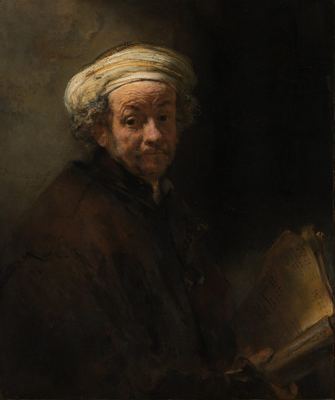
In the pictureAgainst a dark background, an old man, his body turned at an angle, raises his eyebrows and looks toward us. A cloth striped in white and yellowish tones is wound around his head, with gray curls escaping beneath it. His face plainly shows deep furrows across the forehead and a reddish nose and cheeks. His body is lost in a dark brown coat, its form only dimly visible, and at the lower right a worn bundle of manuscript pages in his hand catches the light. At his chest, the dark hilt of a sword pokes out between the folds of the coat. His signature and the date are on the wall at the left.
BackgroundThis is a self-portrait Rembrandt painted in 1661, when he was about fifty-five. He left dozens of self-portraits over his lifetime, and here he takes the role of the biblical figure the apostle Paul. Paul is usually represented with a sword and a letter, and the manuscript in his hand and the sword hilt in his coat are those signs. Rembrandt painted Paul many times from his youth onward. It dates from the years after his 1656 bankruptcy, when he had disposed of his house and collection and was living in hardship, and the unadorned rendering of his lined face gives it a calm, composed feeling.
Puzzle tipThere are only three bright areas: the white cloth on his head, the face, and the manuscript at the lower right, whose yellowed paper shows traces of writing. Assemble these three first and connect the spaces between them. The rest is mostly brown and black, so group pieces of similar brightness together and fill them in following the shift from the relatively light gray-brown wall at the upper left to the deep darkness at the right. Cutting the picture into too many pieces leaves the dark areas hopeless, so a moderate count is best. The recommended piece count is about 48.
- Classification
- Painting
- Medium
- Oil on canvas
- Dimensions
- 91 × 77 cm
- Credit line
- Rijksmuseum, SK-A-4050
Source: Rijksmuseum ↗
Stories about this work
- 16 Must-See Paintings at the Rijksmuseum in Amsterdam
Rembrandt's The Night Watch, Vermeer's The Milkmaid, a Van Gogh self-portrait, plus Hals and Jan Steen. The stories of 16 must-see paintings at the Rijksmuseum, what to check before you go, and how to meet them first as puzzles.