The Edge of the Woods
A dead tree stands against a stormy sky at the edge of a forest, in a Fontainebleau landscape Diaz painted thickly on a wood panel. Full commentary ↓
Couldn't load the puzzle image.
Turn on piece outlines to see piece positions on this picture too
Drag the pieces into place · When zoomed in, drag an empty spot to move around
You can also play with a keyboard — Tab to the board, thenSpace pick a piece, Arrow keys move it (with Shift for small steps),Esc deselect, R rotate a piece (Shift+R the other way)
The Edge of the Woods is an oil painting by Narcisse-Virgile Diaz de la Peña (1872) in the collection of The Metropolitan Museum of Art. It measures 37.8 × 47 cm.
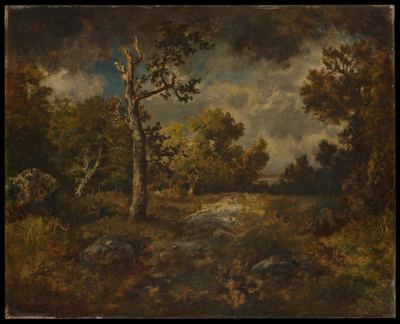
In the pictureA withered tree with almost no leaves reaches into the sky at the center, and behind it a little blue sky opens between dark storm clouds. Dark, leafy trees stand on the left and right, and below is rough ground with rocks and pools. The paint is laid on thickly, leaving the surface uneven.
BackgroundDiaz lost a leg in a childhood accident and walked the Forest of Fontainebleau on an artificial leg to paint. Generous to young painters, he is also known for the story of advising Renoir to lighten his palette. Setting a dead tree against a stormy sky, as here, was a composition he used often, and the texture of paint built up on a wood panel is characteristic of his work.
Puzzle tipThe withered tree in the middle and the blue sky behind it form the axis of the picture. Set up that axis first, then attach the dark woods on the left and on the right. The ground at the bottom separates into gray rocks, light earth and dark pools, and the stormy sky pieces fit together better than you might expect because their brightness varies so much.
- Artist
- French, Bordeaux 1808–1876 Menton
- Classification
- Paintings
- Medium
- Oil on wood
- Dimensions
- 37.8 x 47 cm
- Credit line
- Bequest of Benjamin Altman, 1913
Source: The Metropolitan Museum of Art ↗
Stories about this work
- How to Solve Puzzles with Large Plain Areas Like Sky or Walls
The part of a puzzle where you always get stuck is the part with nothing in it. How to handle plain areas efficiently.
- Two Paintings Where Diaz, Painter of the Fontainebleau Forest, Left the Woods
Even a painter who spent his life painting the Fontainebleau forest on one leg had his exceptions. Diaz seen through a myth outside the forest and a close-up of a single tree.
- What to Know Before Your First 300-Piece Puzzle
A 300-piece puzzle takes more than three times as long as a 100-piece one. What changes on screen, how to finish one section at a time, and which pictures suit a first 300.