Shrine of Saint Lachtin's Arm
A cylindrical arm reliquary covered in knotwork from clenched fist to jeweled end. An early 20th-century copy of an Irish original dated 1106. Full commentary ↓
Couldn't load the puzzle image.
Turn on piece outlines to see piece positions on this picture too
Drag the pieces into place · When zoomed in, drag an empty spot to move around
You can also play with a keyboard — Tab to the board, thenSpace pick a piece, Arrow keys move it (with Shift for small steps),Esc deselect, R rotate a piece (Shift+R the other way)
Shrine of Saint Lachtin's Arm is a stone object by an unknown maker (early 20th century (original dated 1106)) in the collection of The Metropolitan Museum of Art. It measures 38.7 × 6.4 × 7.6 cm.
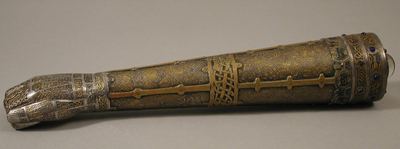
In the pictureThis is a cylindrical arm reliquary lying lengthwise. The silver hand at the left end has its fingers curled into a fist; each finger is divided into compartments with engraved patterns, and a patterned band circles the wrist. The forearm is covered all over its gold ground with fine, dense knotwork; a gold band with round bosses runs along its length, and a wide band of pierced interlace circles the middle. The ring at the right end is set with red and blue stones, and a round crystal rises at the very tip. A long shadow falls beneath the cylinder.
BackgroundThe Met's record dates it "early 20th century (original dated 1106)," so this too is a replica that entered the collection in 1908 through the Rogers Fund. The original is said to have held the arm relic of Lachtin, a 7th-century Irish saint. It is the same length as the shrine of Saint Patrick's hand, 38.7cm, but at just over 7cm thick it is much slimmer, and unlike that one, with its raised fingers, this hand is clenched and held straight. The knotwork covering the surface is regarded as characteristic of early 12th-century Irish metalwork influenced by Viking art.
Puzzle tipThe image is very wide, so the pieces are flat and the gray background above and below is broad. Fix the two ends first with the silver fist at the left and the jeweled ring at the right, then use the lengthwise gold band as a guideline to connect through to the interlace band in the middle. The knotwork pieces look alike, so judge their position by their distance from the gold band. The crystal at the right end catches the light and looks like a white dot, a good landmark. Fill the background starting from the shadow side. 48 pieces is a good fit.
- Culture
- Irish
- Classification
- Reproductions-Metalwork
- Medium
- Bronze, silver, gem stones
- Dimensions
- 38.7 x 6.4 x 7.6cm
- Credit line
- Rogers Fund, 1908
Source: The Metropolitan Museum of Art ↗
Stories about this work
- Why Did the Museum Buy Reproductions of Irish Reliquaries?
The Irish shrines and croziers on this site are not originals but reproductions made in the early 20th century. Why reproductions entered the museum, and tips for solving them as puzzles.