Why Did the Museum Buy Reproductions of Irish Reliquaries?
Published
A 7th-century saint’s crozier and an 11th-century gospel shrine sit side by side. Yet the classification field in the museum’s records reads “Reproductions-Metalwork.” It is easy to assume that objects in a museum are originals, but several Irish reliquaries in the Medieval Art department were classified as reproductions from the moment they came in.
Seven shrines and the dates of the originals
Limiting it to what can be confirmed in the museum’s records, they are as follows. The “original date” in the table is the value the museum wrote next to each title, and all the reproductions were made in the early 20th century.
| Work | Original date | Material |
|---|---|---|
| Crozier of Saint Mura | 7th century | Bronze, silver, gems |
| Shrine of The Gospels of Saint Molaise | 1001–25 | Bronze, silver, gilded silver, gems |
| Shrine of Saint Patrick’s Gospels | 1080–1100 | Bronze, gilded bronze, enamel, gems |
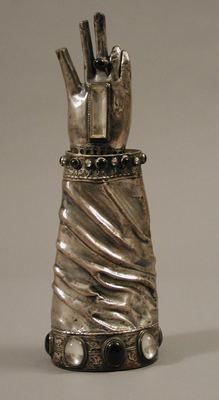
| Shrine of Saint Lachtin’s Arm | 1106 | Bronze, silver, gems |
| Shrine of O’Donnell, Cathach or Battler | 1084 | Bronze, gilding, gems |
| Shrine of Saint Patrick’s Hand | 14th century | Silver, gems |
| Crozier of Crmac McCarthy | 12th century | Copper, enamel, gems |
All are recorded as having come in through the “Rogers Fund, 1908.” It is a set bought all at once, in the same year, with the same fund. Why gather objects like these that are not even originals?
How reproductions crossed the ocean instead of originals
According to the museum’s description, they were made to introduce Ireland’s national treasures to the world and then entered the museum. This repeats the museum’s explanation and has not been independently confirmed. Still, the circumstances can be guessed to some extent.
The originals probably could not have been moved in the first place. It would have been hard for an American museum to buy Irish relics of national-treasure rank, and the original Shrine of Saint Patrick’s Gospels is said to still be in Dublin. The reproductions show the form of those originals in their place. The museum needed to present forms from around the world together for the sake of education, and in the early 20th century it was common to use reproductions in displays. The skill of the makers cannot be dismissed, either. Handling bronze, silver and enamel the way the originals did takes considerable craftsmanship in its own right.
A painting that pretends to be old was a story of copying meant to deceive. This is the opposite: they were brought in openly as reproductions from the start. Imitation can carry very different intentions.
Interlace, animal heads and blue enamel
Being reproductions does not mean there is nothing to see. Because they faithfully copy the originals, the vocabulary of Irish metalwork is gathered in one place.
 Solve this painting as a puzzle → about 5 minutes on Easy
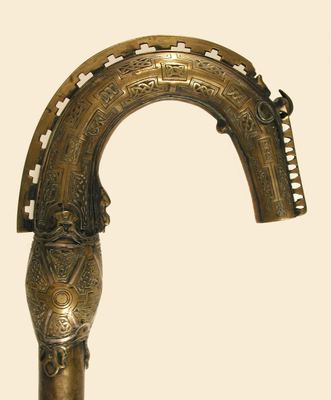
The head of the Crozier of Saint Mura and the surface of the Shrine of Saint Lachtin’s Arm carry Celtic interlace. The lines cross over and under one another and run on without end. Animal heads often appear at the end of a crook or in decorative bands.
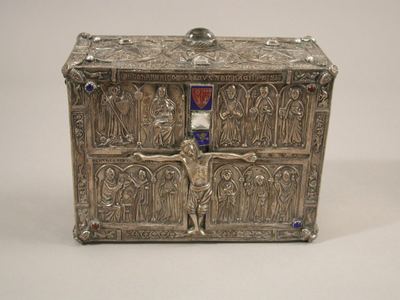
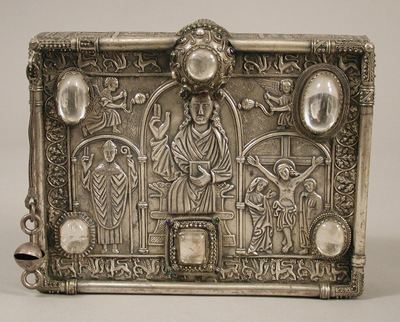
The winged figures carved on the front of the Shrine of The Gospels of Saint Molaise are the symbols of the four Evangelists. The Shrine of Saint Patrick’s Gospels is carved with Christ on the cross and saints, and set with blue enamel and gems.
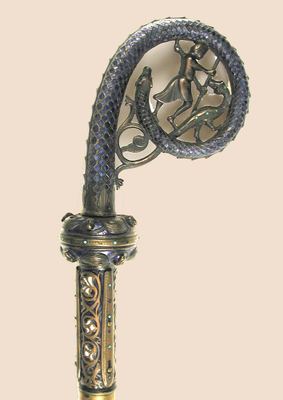
The Crozier of Crmac McCarthy needs to be looked at a little separately. Despite its name, its culture is classified as French. The name comes from a tradition that it belonged to an Irish king, but in form it is an enamel crozier from Limoges in France. It would be a mistake to take them all for Irish objects on the strength of their names alone.
What to rely on when silver pieces run on and on
The dominant tones are silver and bronze, so there are few color clues but many shape clues. The croziers and the arm shrine are almost all outline. In the Crozier of Saint Mura, the shape of the crook cuts across the picture, and Shrine of Saint Patrick’s Hand is shaped like an arm, so it separates easily from the pale background. Build the framework by running pieces along the outline, then fill in the inside by watching the direction in which the pattern flows.
For the box-shaped shrines, the compartments are the frame. The gospel shrines and the Cathach shrine have fronts divided into several compartments, so first fix the four corners with the gem pieces at the corners, then fill in the compartments one by one. Red gems and crystals stand out in color and make ideal reference points. Do not overlook the places where enamel adds color, like the blue enamel of the Shrine of Saint Patrick’s Gospels and the blue serpent scales of the Crozier of Crmac McCarthy.
48 pieces suits the croziers and the arm shrines, and 100 pieces suits the box shrines with dense relief. If pieces with nothing but silver pattern run on and on, try moving to another area, following the tips for when you get stuck.
The hands of craftsmen a hundred years ago
Other small objects from the same department can be seen in small treasures of the Middle Ages. Among them, these reliquaries are easy to pass by simply because they are not originals. But they were an attempt to convey the look of the originals to people who could not go to see them, and a hundred years later that attempt is being put to use again on a puzzle screen. I have reflected once before on makers whose names did not survive, in what “anonymous” means. The devotion with which Irish monasteries enshrined a saint’s relics in a box, the hands of the craftsmen who copied them a hundred years ago, and the person now fitting the pieces together are joined in a single line.