Wall Tile
A small earthenware tile 8 cm on a side, with blue cells set between four white interlaced knots: a 15th-century Spanish wall decoration with a green rim. Full commentary ↓
Couldn't load the puzzle image.
Turn on piece outlines to see piece positions on this picture too
Drag the pieces into place · When zoomed in, drag an empty spot to move around
You can also play with a keyboard — Tab to the board, thenSpace pick a piece, Arrow keys move it (with Shift for small steps),Esc deselect, R rotate a piece (Shift+R the other way)
Wall Tile is a ceramic object by an unknown maker (15th century) in the collection of The Metropolitan Museum of Art. It measures 8 × 7.9 × 1.5 cm.
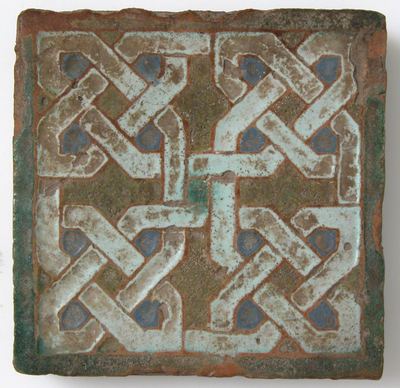
In the pictureInside a small square tile, four groups of knots woven from white bands are arranged two by two, and in the center the bands meet in a cross that links the four groups. In each knot, the four empty cells between the bands are filled with blue glaze, making sixteen blue cells in all. The bands pass alternately over and under one another at each knot. The ground is olive brown with a single turquoise dot at the very center, and red clay lines show at the borders between bands and cells. A rim of green glaze runs around the outside, and the white glaze has flaked and stained in places, so it looks grayish brown.
BackgroundIt shares the same donor, the same year and the same place of manufacture ("Seville or Toledo") in its record as the larger wall tile, but at 8 cm on a side and 1.5 cm thick it is much smaller and uses fewer colors. Small tiles like this were used to fill the bands or corners between large tiles. The white interlaced knots are an example of Islamic ornament absorbed into Spanish Christian architecture, and the cobalt glaze of the blue cells was an expensive color at the time. Whereas the large tile holds only part of a pattern on each sheet, this tile forms a closed composition with all four knot groups on a single tile.
Puzzle tipThe four knot groups are nearly identical, so their positions are easy to confuse. Lay down the central crossing and the turquoise dot first, then run the outer green rim pieces around the four sides. Next, fill the four blue cells of each group to match the direction in which the bands turn. The green rim is worn along the top, showing a lot of red clay, while the sides keep a deep green, which helps tell the orientation. The shapes of the stains where the white glaze has flaked also differ from group to group. 24 pieces work well.
- Culture
- Spanish
- Classification
- Ceramics-Tiles
- Medium
- Earthenware, glaze
- Dimensions
- 8 x 7.9 x 1.5 cm
- Credit line
- Gift of Garrett Chatfield Pier, 1908
Source: The Metropolitan Museum of Art ↗
Stories about this work
- From Andirons to Wall Tiles: Five Medieval Objects Without a Single Saint
No saints, no kings. Iron that held up firewood, tiles that covered walls, a marble roundel that decorated a building. Everyday objects and architectural ornament from the Middle Ages that are not religious art.