Panel
An oak panel with vertical ridges and rounded ends: a 16th-century European linenfold-type panel used to decorate furniture and wall paneling. Full commentary ↓
Couldn't load the puzzle image.
Turn on piece outlines to see piece positions on this picture too
Drag the pieces into place · When zoomed in, drag an empty spot to move around
You can also play with a keyboard — Tab to the board, thenSpace pick a piece, Arrow keys move it (with Shift for small steps),Esc deselect, R rotate a piece (Shift+R the other way)
Panel is a wooden object by an unknown maker (16th century) in the collection of The Metropolitan Museum of Art. It measures 51.8 × 29.8 × 1.1 cm.
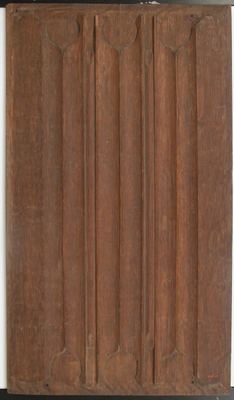
In the pictureLong vertical ridges are carved into a tall brown wooden panel. At the top and bottom ends, three rounded leaf-shaped terminals face each other, and from each terminal a thin ridge runs the length of the panel. In the two narrow bands between them, small bud shapes are carved near the top and bottom ends. Both sides are wide flat borders, small nail holes can be seen near the four corners, and the accession number 08.81.17 is written in red at lower right. A dark strip shows at the top edge of the photograph and a little white margin on the left.
BackgroundThe Met's record describes it as a 16th-century European panel, giving the material as "Wood (oak ?)" with a question mark. It measures 51.8×29.8 cm and is thin, at 1.1 cm thick. Linenfold, a pattern that looks like cloth folded and stood on end, was widely used in northern Europe in the 15th and 16th centuries to decorate chests, doors and wall paneling, and it was left unpainted, getting its effect from light and shadow. The name linenfold itself is said to have been coined in the 19th century. The rounded terminals on this panel appear to be a simplified form of the ends of the folded cloth. It came to the museum in 1908 through the Rogers Fund.
Puzzle tipBeing almost a single color, this is one of the hardest puzzles on the site. Place the six rounded terminals at top and bottom and the red number piece at lower right first, fixing the four corners and the horizontal positions. Then work downward along the shadow lines of the vertical ridges, and match the flat side borders by the direction of the wood grain and slight differences in color. The white margin on the left and the dark strip at the top are clues for the edges. 24 pieces is recommended.
- Culture
- European
- Classification
- Woodwork-Furniture
- Medium
- Wood (oak ?)
- Dimensions
- 51.8 x 29.8 x 1.1 cm
- Credit line
- Rogers Fund, 1908
Source: The Metropolitan Museum of Art ↗
Stories about this work
- Reading the Lost Color in Four Medieval Sculptures
These sculptures, which now look like white stone or brown wood, were originally brightly painted. What can we read in the places where the color has vanished?