Shrine of Saint Patrick's Hand
A silver arm-shaped reliquary with raised fingers and jeweled bands, an early 20th-century copy of a 14th-century Irish original. Full commentary ↓
Couldn't load the puzzle image.
Turn on piece outlines to see piece positions on this picture too
Drag the pieces into place · When zoomed in, drag an empty spot to move around
You can also play with a keyboard — Tab to the board, thenSpace pick a piece, Arrow keys move it (with Shift for small steps),Esc deselect, R rotate a piece (Shift+R the other way)
Shrine of Saint Patrick's Hand is a stone object by an unknown maker (early 20th century (original dated 14th century)) in the collection of The Metropolitan Museum of Art. It measures 38.7 × 13.3 × 10.8 cm.
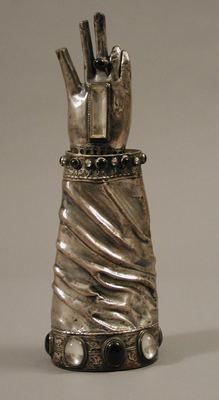
In the pictureA silver arm-shaped reliquary stands upright against a gray background. The hand at the top has the thumb and two fingers extended and the others bent; a long rectangular crystal is set in the middle of the hand, and a black stone sits below the fingers like a ring. At the wrist is a band set with alternating red and white stones, and the sleeve below has deep folds running on a diagonal. The bottom band is set with alternating black and clear stones, with small animals engraved between them.
BackgroundThis too is not the original. The Met's record dates it "early 20th century (original dated 14th century)," and it belongs to a group of copies of Irish reliquaries acquired through the Rogers Fund in 1908. Arm-shaped reliquaries held relics such as a saint's arm bone, and their blessing-hand shape made them well suited to being held up during rites. Saint Patrick is the 5th-century saint who brought Christianity to Ireland. The crystal set in the hand was probably a window for viewing the relic inside. At 38.7 cm tall it matches the length of the Shrine of Saint Lachtin's Arm, but this one is photographed standing, and it flares out below the wrist.
Puzzle tipThe picture is tall and narrow, so it is easiest to work from top to bottom. Fix the top with the outline of the fingertips and the rectangular crystal, then set the upper and lower boundaries with the jeweled band at the wrist and the large oval stones of the bottom band. Join the sleeve folds between them by following the diagonal of the reflected light. The shadow cast to the right of the base is another clue for the bottom. Fill in the gray background pieces last. 48 pieces work well.
- Culture
- Irish
- Classification
- Reproductions-Metalwork
- Medium
- Silver, gem stones
- Dimensions
- 38.7 x 13.3 x 10.8 cm
- Credit line
- Rogers Fund, 1908
Source: The Metropolitan Museum of Art ↗
Stories about this work
- Why Did the Museum Buy Reproductions of Irish Reliquaries?
The Irish shrines and croziers on this site are not originals but reproductions made in the early 20th century. Why reproductions entered the museum, and tips for solving them as puzzles.