South Wind, Clear Sky (Gaifū kaisei), also known as Red Fuji, from the series Thirty-six Views of Mount Fuji (Fugaku sanjūrokkei)
Mount Fuji glowing red in the early morning sun under a blue sky with rows of white clouds: the simplest, boldest print in Thirty-six Views of Mount Fuji. Full commentary ↓
Couldn't load the puzzle image.
Turn on piece outlines to see piece positions on this picture too
Drag the pieces into place · When zoomed in, drag an empty spot to move around
You can also play with a keyboard — Tab to the board, thenSpace pick a piece, Arrow keys move it (with Shift for small steps),Esc deselect, R rotate a piece (Shift+R the other way)
South Wind, Clear Sky (Gaifū kaisei), also known as Red Fuji, from the series Thirty-six Views of Mount Fuji (Fugaku sanjūrokkei) is a woodblock print by Katsushika Hokusai (ca. 1830–32) in the collection of The Metropolitan Museum of Art. It measures 24.4 × 35.6 cm.
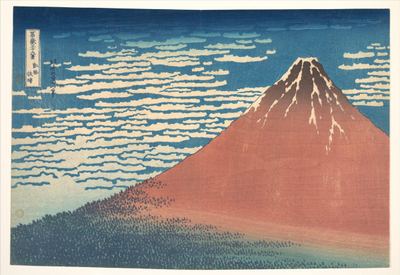
In the pictureA single Mount Fuji fills most of the picture. The mountain is reddish brown in the early morning sunlight, snow remains in white streaks near the summit, and the lower slopes are dark green forest. The sky is a blue that deepens toward the top, with white clouds like ripples lined up horizontally across it. There are no people, boats or houses.
BackgroundAlongside Under the Wave off Kanagawa, it is the most famous print in Thirty-six Views of Mount Fuji, and it is commonly called Red Fuji. It captures the moment when, on a clear late-summer day with a south wind blowing, the mountain looks red in the dawn light. With only three colors (reddish brown, green and blue) and a single triangular form, the woodblock technique of layering colors is laid bare.
Puzzle tipAs a puzzle it looks simple, but it gets hard if you let your guard down. Place sky pieces vertically by the depth of the blue, which darkens toward the top, and horizontally by the cloud pattern. The red face of the mountain retains faint traces of the woodblock grain, which you can make out when zoomed in. Joining the boundary lines of the snow at the summit and the forest at the foot first gives you the shape of the mountain.
- Artist
- Japanese, Tokyo (Edo) 1760–1849 Tokyo (Edo)
- Period
- Edo period (1615–1868)
- Culture
- Japan
- Classification
- Prints
- Medium
- Woodblock print; ink and color on paper
- Dimensions
- 24.4 x 35.6 cm
- Credit line
- Rogers Fund, 1914
Source: The Metropolitan Museum of Art ↗
Stories about this work
- A Wave, a Red Fuji and a Plum Branch: Three Prints by Hokusai and Hiroshige as Puzzles
Under the Wave off Kanagawa, the most reproduced print in the world; Red Fuji; and Hiroshige's plum garden, which Van Gogh copied in oil. Why woodblock prints work so well as puzzles.
Puzzles to try next
More Japanese Prints & Paintings puzzles· Stories and puzzle tips