A Wave, a Red Fuji and a Plum Branch: Three Prints by Hokusai and Hiroshige as Puzzles
Published
Hokusai’s wave is on T-shirts, in emoji, and on neighborhood café signs. It is so common that people rarely get around to looking at it properly. Surprisingly few know which series it belongs to and what that series set out to depict, why Mount Fuji is smaller than the wave, or why Red Fuji, from the same series, is said to be trickier. With three prints released by the Metropolitan Museum of Art now up as puzzles, here is that story.
| Work | Artist | Series | Date |
|---|---|---|---|
| Under the Wave off Kanagawa | Katsushika Hokusai | Thirty-six Views of Mount Fuji | early 1830s |
| South Wind, Clear Sky (Red Fuji) | Katsushika Hokusai | Thirty-six Views of Mount Fuji | early 1830s |
| Flowering Plum Tree | Utagawa Hiroshige | One Hundred Famous Views of Edo | 1856–58 |
A Small Mount Fuji Beyond the Trough of a Wave
 Solve this painting as a puzzle → about 5 minutes on Easy
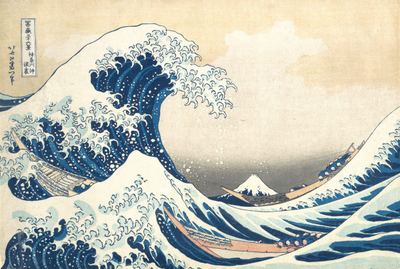
In Under the Wave off Kanagawa, a huge wave rises from the left side of the picture and collapses toward the right, its white foam raised like claws. Beneath it, three long, narrow boats carrying people row against the waves. Beyond the trough the wave has carved out, a snow-covered Mount Fuji sits, tiny.
It is the first sheet of the series Thirty-six Views of Mount Fuji, which Hokusai published at around the age of seventy. The whole series is built around the question of where and how Mount Fuji can be seen, so making the mountain smaller than the wave is a deliberate play on point of view. The deep blue of the wave was possible because of Prussian blue, a pigment that had just arrived from Europe at the time. Because it is a woodblock print, thousands of copies of the same image were printed, and in the late 19th century it crossed to Europe and reached Monet, Van Gogh and even Debussy.
A Red Mountain with No People or Boats
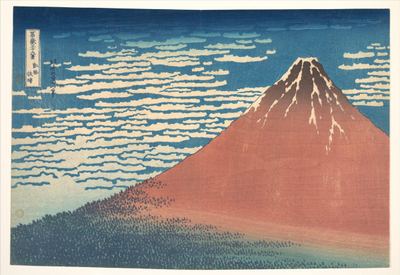
The sheet from the same series that rivals the wave in fame is South Wind, Clear Sky, the picture commonly called Red Fuji. Mount Fuji alone takes up almost the whole picture. Lit by early morning sun, the mountain is reddish brown, snow lingers in white streaks near the summit, and the foothills are dark green forest. The sky is a blue that deepens toward the top, and above it white clouds like ripples line up horizontally. There are no people, no boats, no houses. It depicts the moment the mountain turns red in the dawn light, on a clear late-summer day when the south wind blows. Three colors, one triangle for a shape. Few pictures show so plainly how a woodblock print layers its colors.
The Plum Tree Van Gogh Copied in Oil
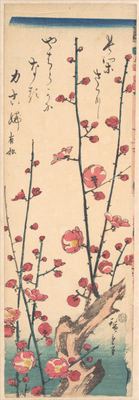
Flowering Plum Tree is a sheet from Hiroshige’s last series, One Hundred Famous Views of Edo. A thick black plum branch cuts across the front of the picture, dotted with white plum blossoms. Beyond it are a red-tinged sky, green ground, and small figures inside a fence admiring the blossoms. It is a bold composition that makes what is near absurdly large and what is far very small.
This plum tree at Kameido was a famous sight, called the “Garyōbai (Sleeping Dragon Plum)” because its branches crept along the ground and stretched out like a dragon. Van Gogh copied this print faithfully in oil in Paris in 1887, and that painting is now in Amsterdam. That is the same year as the Paris-period self-portrait in the post on six Van Gogh paintings. Behind Van Gogh’s short strokes of color and bold compositions stood prints like this one.
Boundaries as if Cut with a Knife, and Wide Single-Color Areas
Move from oil painting puzzles to print puzzles and you notice right away: the boundaries between colors are as crisp as if cut out with a knife. In a woodblock print, a separate block is carved for each color and printed one over another, so no in-between zone forms where two colors mix. A piece where the blue wave meets white foam, or where the black branch meets the red sky, is placed as soon as you see it.
That is why, for all three, it is fastest to start by joining the boundary pieces. In the wave picture, build the outline of the wave from the pieces where blue and white foam meet, and the rest follows on its own. In the plum garden, fit the branch pieces by the positions of the white blossom dots.
Prints, however, have a trap that oil paintings do not: wide single-color areas. The sky in the wave picture, and the sky and mountain slope in Red Fuji, are like this. Usually such pieces go in at the very end, filling the empty spaces, following the solid background strategy, but Red Fuji is a bit different. The sky darkens toward the top, so you can place pieces vertically by depth of color and horizontally by the cloud pattern. Faint woodgrain also remains on the red face of the mountain, so you can tell pieces apart if you zoom in. It is the kind of picture where it is easy to choose 100 pieces because it looks simple and then get stuck in the sky. If it is your first time, go with 48 pieces.
The plum garden is a very tall picture (1 wide to 2.9 tall), so the pieces line up in long vertical rows. Finish the bottom band with the figures and the fence first, then build up the branch. Vertical pictures fit especially well on a phone, so it is also a good pick for a first puzzle with a child.
Joseon-dynasty paintings made of shades of ink are collected in the Korean painting puzzle guide. Both are East Asian pictures, but where the print draws its boundaries with a knife, ink dissolves its boundaries into a blur. The hand fitting the puzzle feels that difference too. In a print you look for lines; in an ink painting you look for the places where lines disappear.
Frequently asked questions
Why is Mount Fuji smaller than the wave in Under the Wave off Kanagawa?
This print is the first sheet of Hokusai's series Thirty-six Views of Mount Fuji, and the whole series is about where and how Mount Fuji can be seen. Placing a small Mount Fuji beyond the trough of the wave is a play on point of view.
How is a print puzzle different from an oil painting puzzle?
In a woodblock print, a separate block is carved for each color and printed one over another, so there is no in-between zone where two colors mix, and the boundaries between areas of color are as crisp as if cut with a knife. That makes it fast to start by joining the boundary pieces, but wide single-color areas like the sky become a trap.
Red Fuji looks simple, so why is it called difficult?
With only three colors and a single triangle for a shape, it looks easy, but the sky and the mountain slope are wide single-color areas. You have to place the sky vertically by the depth of the blue, which darkens toward the top, and horizontally by the cloud pattern, so 48 pieces is right for a first try.