Four Sketches by Frank Waller of the Met in Its 14th Street Days
Published
In the middle of a narrow gallery stands a bust ringed by a railing, and ceramics line a shelf high on the wall. Through an open door, a few visitors can be seen. It is a sketch of a gallery at The Metropolitan Museum of Art in New York, but not the enormous building beside Central Park that we know. The puzzles here all come from collections the Met has opened to the public, and among them are pictures in which the museum depicts its own former home.
Four sheets by Frank Waller (1842–1923) in the drawings department are just that. Each title includes the words “14th Street,” and they show the galleries and stairway of the old museum.
From 14th Street to Central Park
Today the Met occupies a grand building beside Central Park, but it was not there from the start. According to the museum’s description, it rented a mansion on 14th Street from 1873 to 1880, and in 1880 moved to its present building on Central Park.
These four sheets are a record made just before the move. Two are dated 1879 and 1880; the other two are undated but appear to have been drawn around the same time. The artist caught rooms that were soon to be emptied.
Working from these sketches, Waller completed the oil painting “Interior of the Metropolitan Museum of Art when in 14th Street” in 1881. What is here is not that painting but the preparation that led to it. It feels like taking a quick look at the artist’s worktable.
Pencil, pen, chalk and ink
Each of the four uses different materials. Here they are, exactly as listed in the museum’s records.
| Work | Date | Medium |
|---|---|---|
| Room “M” in The Metropolitan Museum of Art in 14th Street | Undated | Pen, ink and graphite |
| Sketch of Room “M” in The Metropolitan Museum of Art when in 14th Street | 1879 | Graphite heightened with white |
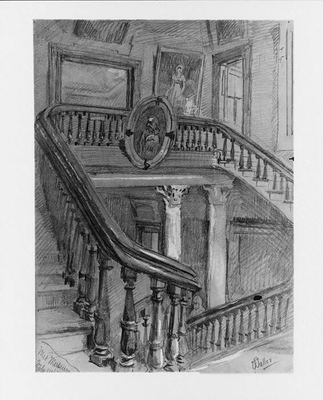
| Stairway and balcony, study (pencil) | Undated | Pencil and chalk |
| Stairway and balcony, study (wash) | 1880 | India ink wash |
Graphite is used to block in forms quickly, and a touch of white on top brings out the places that catch the light. Pen and ink is the stage where lines are fixed. India ink wash is a method of dissolving ink in water and brushing in light and shade.
 Solve this painting as a puzzle → about 5 minutes on Easy
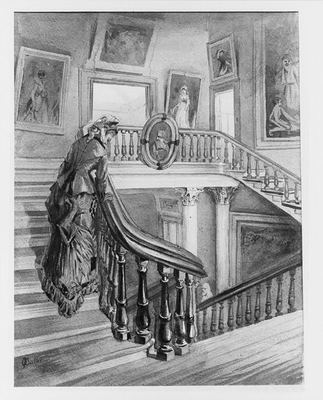
He drew the stairway twice, once in pencil and chalk and once in India ink wash. The railing rising through two turns and the frames hung on the wall are in nearly the same composition. The pencil sheet is closer to groundwork, settling each baluster and the placement of the pictures, while the wash sheet adds light and shade and moves a step further toward completion. They are traces of looking at the same place again with a change of tools. Graphite would have suited blocking in forms quickly, pen suited fixing lines, and ink suited testing light and shadow. Because two sheets are undated, we cannot say for certain which came first. Still, set the four together and you can see an artist’s hand taking one space apart in several ways for the sake of a single oil painting.
A narrow room in a mansion
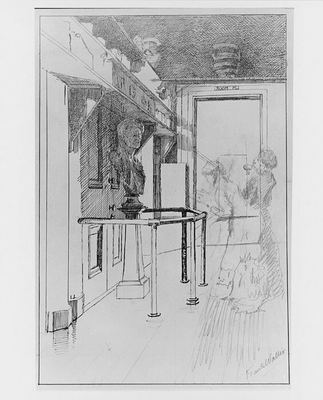
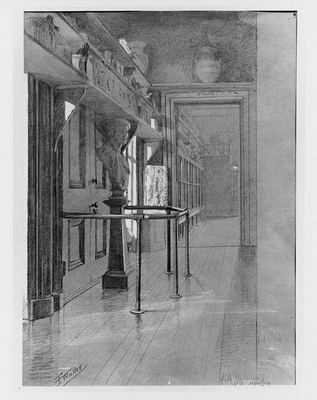
The scene described at the very beginning is the Room “M” drawing. As the commentary on the puzzle page also notes, a bust ringed by a railing stands in a narrow gallery, ceramics line a shelf high on the wall, and visitors can be seen through the open door.
It differs from the galleries of today’s museum in scale to begin with. In the days when a few rooms of a mansion served as galleries, the rooms must have been narrow and the ceilings low. A single drawing shows that today’s enormous museum, too, started out in rooms like this.
Start with the pieces that have bold lines
All four sheets have almost no color, so color will not solve them. Look at the weight of the lines instead. Dark areas such as the straight lines of the door frames, the vertical posts of the railing and the dark mass of the bust become reference points. Pieces where lines are sparse, such as floor and wall, cannot be told apart on their own, so use the grid overlaid on the preview to estimate where they go. The blank paper margins with no drawing tend to be left until last, so work from the outside in. It is the same technique used for pictures made only of line and tone, like Goya’s bullfight prints.
24 or 48 pieces is about right. In pictures with no color clues, fewer pieces actually make it more fun.
Three parties looking into the same room
We can put these sketches together as puzzles because the Met has opened its collection images for anyone to use. It is thanks to the policy discussed in why the paintings on this site are free.
The museum released even the sketches of its own former self, and we fit them together piece by piece. The museum, the artist and the person sitting at the puzzle are looking into the same room across more than 100 years. Few pictures fit the “looking for a long time” discussed in learning to look at art through puzzles as well as this one. As you join the railing around the bust one piece at a time, it feels as if you are standing for a moment in that room on 14th Street, now long gone.