Statue of an asymmetrically seated man
A man seated with one knee raised and covered by his cloak, a 13.5 cm yellow limonite statuette said to come from el-Tarif at Thebes. Full commentary ↓
Couldn't load the puzzle image.
Turn on piece outlines to see piece positions on this picture too
Drag the pieces into place · When zoomed in, drag an empty spot to move around
You can also play with a keyboard — Tab to the board, thenSpace pick a piece, Arrow keys move it (with Shift for small steps),Esc deselect, R rotate a piece (Shift+R the other way)
Statue of an asymmetrically seated man is a work by an unknown maker (ca. 1981–1550 B.C.) in the collection of The Metropolitan Museum of Art.
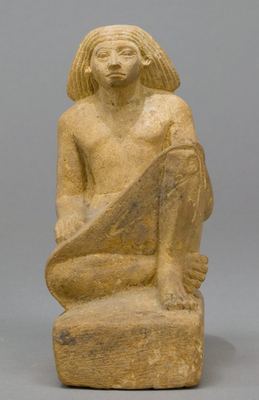
In the pictureA small man carved from yellow stone sits on a square base. His right leg is folded forward and laid flat on the ground while his left knee is raised high, and a fold of the cloak falling from his shoulder covers the raised knee in a large triangle. His right hand rests on the folded leg, and the foot of the raised leg is placed at the front of the base. A wig incised with lines sweeps behind his ears to touch his shoulders, and his face looks straight ahead. There are dark stains here and there on the surface. His chest is bare, and the expression of his elongated eyes and closed mouth is calm.
BackgroundEgyptian sculpture is known for strictly observing symmetry and frontality, but a pose with one knee raised like this is sometimes seen in small statues of private individuals rather than gods or kings. The museum's record gives a broad date from the Middle Kingdom to the early New Kingdom (Dynasties 12–18, about 1981–1550 B.C.) and notes that it is said to have come from the Intef cemetery at el-Tarif in Thebes. The material is yellow limonite and the height 13.5 cm; it was bequeathed by Theodore M. Davis in 1915. Wrapping the body in a cloak is a form of dress commonly seen in private statues of the Middle Kingdom.
Puzzle tipIt is a small stone of even color, so even with few pieces it is no pushover. Find the large triangle formed by the raised knee and the cloak first, and anchor the top with the fine stripes of the wig and the face pieces. Fit the base by its square outline at the bottom, and fill in the gray background starting from the pieces along the statue's edge. The feet and toes at the front of the base are small, clearly shaped reference points, and the dark stains fall in a different place on each piece, which makes them good for checking against the preview. We recommend 24 pieces.
- Period
- Middle Kingdom–Early New Kingdom
- Dynasty
- Dynasty 12–18
- Medium
- Yellow limonite (G.L.Finlay)
- Dimensions
- H. 13.5 cm (5 5/16 in); W. 6 cm (2 3/8 in); D. 9.5 cm (3 3/4
- Credit line
- Theodore M. Davis Collection, Bequest of Theodore M. Davis, 1915
Source: The Metropolitan Museum of Art ↗
Stories about this work
- Three Middle Kingdom Egyptian Statues That Hide the Body in a Cloak
Statues that cover the limbs with a cloak instead of carving them, turning the body into a single block. Why did this form, which saved stone and labor, become popular?