Three Middle Kingdom Egyptian Statues That Hide the Body in a Cloak
Published
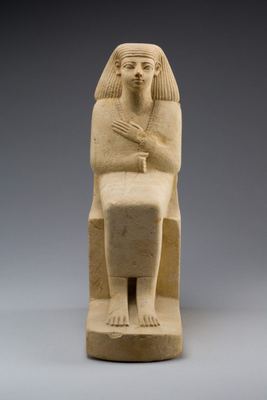
The body of a man seated on a chair looks like a single smooth block of stone from shoulders to toes. Neither the arms nor the legs were carved separately, because a cloak covers the whole body. From the sculpture of Egypt’s Middle Kingdom, we chose three pieces that show this block form well: one seated statue, one standing statue, and one small statue that departs slightly from the form.
| Work | Pose | Material | Period |
|---|---|---|---|
| Statue of a Seated Man in a Cloak | Seated | Limestone | Middle Kingdom (Dynasty 13) |
| Statuette of a Cloaked Man | Standing | Yellow limestone | Middle Kingdom (mid-Dynasty 12 or later) |
| Statue of an asymmetrically seated man | One knee raised | Yellow limonite | Middle Kingdom to early New Kingdom (Dynasties 12–18) |
Why the limbs were not carved
 Solve this painting as a puzzle → about 5 minutes on Easy
The man in Statue of a Seated Man in a Cloak sits on a backless seat. He wears a wig that reaches his shoulders and a necklace, and his whole body is wrapped in a cloak. The only thing that emerges from the cloak is one hand resting on his chest.
There were practical reasons this form became popular. Thin, projecting parts like arms and legs break easily during carving and take a lot of time. Covering them with a cloak and making the figure one block means less broken stone and less labor. For medium-sized statues dedicated in temples or placed in tombs, those advantages were considerable.
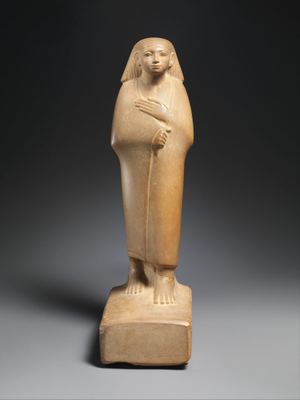
Statuette of a Cloaked Man was made on the same principle. The standing body, wrapped in an ankle-length cloak, is simplified like a single column. It was a method chosen to carve less stone, yet the result left a neat and refined impression instead. It is also worth noting that the base was carved from the same block.
Neither man’s name has survived. There are clues for guessing, though. The wig and necklace of the seated statue tell us he was a person of some standing, and the smoothly finished surface of the standing statue shows the effort put into it. Though the names are gone, the quality of the carving and the ornaments quietly speak for their rank.
A small statue with one knee raised
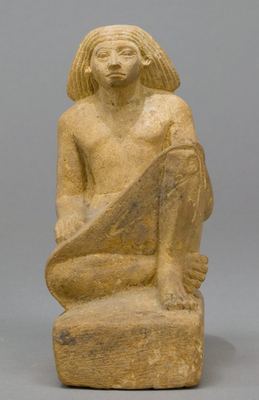
Statue of an asymmetrically seated man has a different character from the first two. It is a statuette only 14 centimeters high, seated with one knee raised and the other leg folded.
Egyptian sculpture is often said to have strictly kept to symmetry and frontality. Yet this pose, with one knee raised, turns up fairly often in small private statues of the Middle Kingdom. A statue standing in a great temple, or a statue of a king, would have kept the rules, but for small, personal objects belonging to ordinary people, the rules appear to have been applied loosely. Such statuettes, which would have been placed in tombs or temples, are also said to have varied widely depending on the skill of the maker. It is a sculpture that shows where the official norms grew slack.
The same idea, different choices
Set the three side by side and, even within the same idea of covering the body with a cloak, the choices diverge a little. The seated statue has the stability that comes from its seated pose. The standing statue rises straight like a column, and the asymmetrical seated statue has the freedom of slipping slightly outside the rules. The materials all differ too: white limestone, yellow limestone, and yellow limonite. Compared with the nameless royal statues that show their rank with headdresses and cobras, these people left themselves behind in a much quieter way.
The face and wig are the starting point
Because the bodies are simplified, all three are actually on the easier side to assemble compared with complex sculptures. The areas with the most detail are the face and the wig. Assemble those first and it is settled which way the figure is facing.
The cloaked torso has almost no pattern, so the pieces look alike. Sort them by which way the faint shadows fall, and it is better to assemble the boundary where the cloak meets the background first and then fill in the inside. The hand emerging from the cloak and the feet on the base have clear shapes and make good reference points. In the asymmetrical seated statue, the diagonal formed by the raised knee is the most distinctive outline, so once you find that piece, the rest of the pose follows. Easy (about 24 pieces) or Normal (about 48) is right. For the small asymmetrical seated statue, we recommend starting with 24 pieces.
These three pieces are neither showy nor large. They began from a calculation not to carve the limbs, and that calculation led to a neat, geometric beauty. Other conventions of Egyptian sculpture can be found in Conventions of Egyptian sculpture, and sculptures of people who were not royalty in Egyptian statues of commoners. It is a little remarkable that a craftsman’s choice to save stone still looks refined today.