Surprised, or Infidelity Found Out
Lovers meeting in the woods are caught by surprise as cupids dart between them, an allegory by Dietrich in imitation of Watteau's fêtes galantes. Full commentary ↓
Couldn't load the puzzle image.
Turn on piece outlines to see piece positions on this picture too
Drag the pieces into place · When zoomed in, drag an empty spot to move around
You can also play with a keyboard — Tab to the board, thenSpace pick a piece, Arrow keys move it (with Shift for small steps),Esc deselect, R rotate a piece (Shift+R the other way)
Surprised, or Infidelity Found Out is an oil painting by Christian Wilhelm Ernst Dietrich in the collection of The Metropolitan Museum of Art. It measures 73 × 72.7 cm.
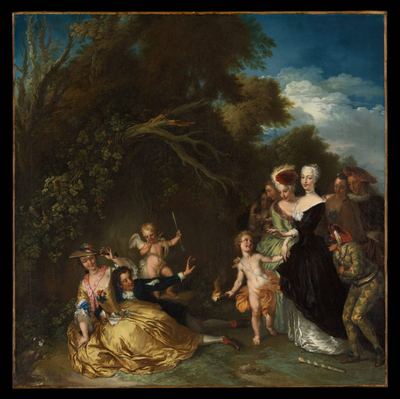
In the pictureBeneath a large tree, a woman in a yellow dress sits with a man, while from the right a woman in a black dress with white sleeves approaches with her maid. Between them two winged cupids run about holding a bow and a torch, and at the far right is a jester in motley. The sky is blue with floating clouds.
BackgroundAs the title says, it shows the moment an illicit meeting is discovered, borrowing the form of the "fête galante" made fashionable by Watteau and his followers. The cupids and the jester are devices signaling that this is a theatrical, staged scene, and who the woman in black is remains up to the viewer's interpretation. Dietrich moved freely among the styles of different countries in this way, keeping collectors satisfied.
Puzzle tipThe picture divides into yellow dress, black dress, blue sky and green trees, so sorting by color is easy. Fit the figures' faces and the jester's multicolored pieces first, and fill in the tree greens starting from the pieces that border the sky. It is close to square, so it can be enjoyed at up to 300 pieces.
- Artist
- German, Weimar 1712–1774 Dresden
- Classification
- Paintings
- Medium
- Oil on canvas
- Dimensions
- 73 x 72.7 cm
- Credit line
- Purchase, 1871
Source: The Metropolitan Museum of Art ↗
Stories about this work
- Dietrich, the Painter Who Could Be Rembrandt or Watteau
Like Rembrandt, then like Rembrandt's night scenes, then like Watteau. Three styles that the Dresden court painter Dietrich moved between at will.