Dietrich, the Painter Who Could Be Rembrandt or Watteau
Published
When people hear of a painter who imitated other painters’ styles, they usually think of forgers first. So it was with the subject of A painting that pretends to be old. But there was also a painter who, far from hiding his imitation, made it his calling card: Christian Wilhelm Ernst Dietrich, an 18th-century German court painter.
| Work | Date | Size | What it imitates |
|---|---|---|---|
| Christ Healing the Sick | 1742 | 89.2 × 105.1 cm | Rembrandt’s print |
| The Adoration of the Shepherds | 1760s | 54.9 × 73 cm | A Rembrandt-style night scene |
| Surprised, or Infidelity Found Out | Undated | 73 × 72.7 cm | A Watteau-style fête painting |
Dietrich was born in Weimar and died in Dresden in 1774. All three are oil paintings on canvas.
The Hundred Guilder Print on canvas
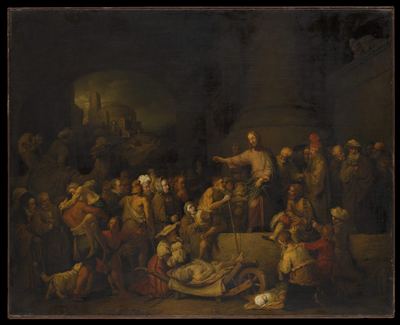 Solve this painting as a puzzle → about 5 minutes on Easy
In Christ Healing the Sick, dozens of people gather under a dark arch, and at the center Christ raises his hand toward the sick. The composition closely follows Rembrandt’s famous print Christ Healing the Sick, the so-called Hundred Guilder Print.
As a court painter in Dresden, Dietrich became known across Europe for his skill at handling the styles of Rembrandt and the Dutch painters at will. Far from being a flaw, imitation became the foundation of his reputation.
A barn lit by a single lamp
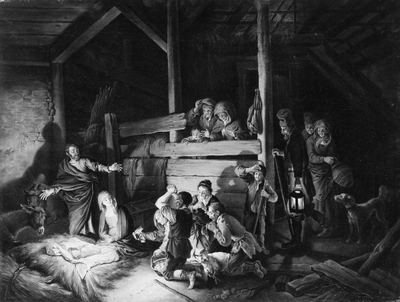
The Adoration of the Shepherds shows shepherds gathered around the infant Jesus in a dark barn crossed by wooden beams. Lighting the whole picture with a single lamp is a night-scene technique favored by 17th-century Dutch painters. Because the adoration of the shepherds took place at night, it was often painted as a night scene like this, and Dietrich revived that tradition in mid-18th-century Dresden. The rough timber, the lamplight, the humble figures: all of it was learned from Rembrandt’s prints.
You see Rembrandt’s shadow twice in one painter: once in the daytime scene of healing the sick, and again in the night scene of the shepherds gathering. A style fashionable in the Netherlands about a hundred years earlier came back to life at an 18th-century German court.
Rococo by the same hand
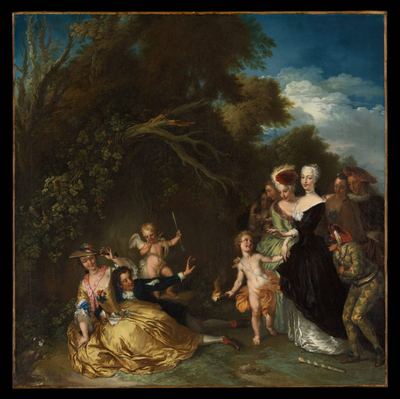
Surprised, or Infidelity Found Out has an entirely different mood. Under a large tree, a man and woman meeting in secret are caught, while cupids and a jester look on. It borrows the “fête painting” format made fashionable by Watteau and his followers.
Antoine Watteau is a leading painter of French Rococo, known for the “fête galante,” pictures of elegant outdoor gatherings of aristocrats. The hand that painted Rembrandt-style religious pictures here follows Watteau’s light, French-style scenes instead. The cupids and the jester signal a scene staged like theater. Who the woman in black is remains for the viewer to decide.
The difference between a forger and Dietrich
The forger in A painting that pretends to be old tried to sell his own work as that of another era and another person. Dietrich sold his paintings under his own name. He did not hide that he painted after Rembrandt or Watteau, and that was precisely what counted as his talent.
For 18th-century European collectors, genuine Rembrandts and Watteaus were hard to come by. Painters like Dietrich painted the styles they wanted to order: Rembrandt-style if a Rembrandt-style religious picture was needed, Watteau-style if a Watteau-style fête painting was needed. That such different pictures came from one man’s hand shows what the art market of the time looked like.
Two dark paintings and one bright one
Different styles call for different solving methods. The Rembrandt-style Christ Healing the Sick and The Adoration of the Shepherds are compositions with bright areas floating in darkness. Start with the brightest pieces, Christ’s white robe and the area around the lamp, then fill in the dark pieces from the edges inward using the density-sorting method covered in Drawings by Degas and Lautrec. Christ Healing the Sick has dozens of figures, so it is less tiring to group them in threes and fours and finish one group at a time.
In Surprised, the yellow dress, the black dress, and the blue sky are clearly separated, which makes it easy to divide by color zone. Use small but clearly shaped figures, like the cupids and the jester, as reference points. For piece count, Hard (about 100 pieces) suits the two paintings with many figures, and 48 to 100 pieces suits Surprised.
Dietrich’s paintings stir a strange kind of admiration. They are neither Rembrandt nor Watteau, yet they look like Rembrandt and like Watteau. For someone who owned this many ways of seeing through other people’s eyes, you start to wonder what his own eye was like. As you solve the three one after another, that question keeps lingering between the pieces.