The Threatened Swan
A swan spreads its wings and cries out against a dog approaching its nest: the very first painting bought by the forerunner of the Rijksmuseum. Full commentary ↓
Couldn't load the puzzle image.
Turn on piece outlines to see piece positions on this picture too
Drag the pieces into place · When zoomed in, drag an empty spot to move around
You can also play with a keyboard — Tab to the board, thenSpace pick a piece, Arrow keys move it (with Shift for small steps),Esc deselect, R rotate a piece (Shift+R the other way)
The Threatened Swan is an oil painting by Jan Asselijn (ca. 1650) in the collection of Rijksmuseum. It measures 144 × 171 cm.
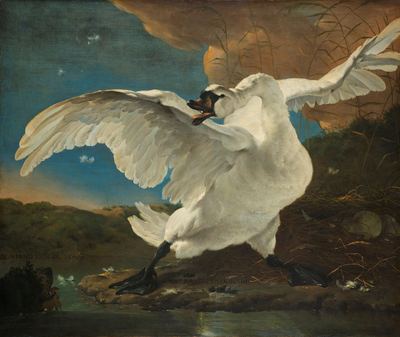
In the pictureA single white swan fills almost the entire picture. With its wings spread wide to both sides and its neck twisted, it opens its orange bill and cries out toward the lower left. In the nest in the grass on the right lie eggs, and at the water's edge at lower left a black dog pokes its head out as it approaches. The background is blue sky on the left and orange clouds and reeds at upper right, and plucked feathers drift in the air. Small Dutch inscriptions read 'the Grand Pensionary' beneath the swan, 'Holland' on an egg and 'the enemy of the state' above the dog.
BackgroundJan Asselijn (1610–1652) was a landscape and animal painter who worked in Amsterdam after spending time in Italy. The painting itself shows a fight between a swan guarding its nest and a dog, but it was later read as a political allegory. The white swan was interpreted as Johan de Witt, Holland's highest official, who was murdered in 1672, defending the country from its enemies, and the inscriptions in the painting are thought to have been added after the painter's death to fit that interpretation. According to the museum, carrying that meaning, the painting became the first purchase of the National Art Gallery (the forerunner of the Rijksmuseum) in 1800.
Puzzle tipThe white swan is the biggest clue, but its feathers are similar in color, so first use the black face, the orange bill and the two black webbed feet as reference points. Next, join the outline of the wings along the boundary between the blue sky on the left and the orange clouds on the right. The dry grass and eggs of the nest and the black dog at lower left stand out in the dark lower part of the picture. The strip along the very bottom, where dark water and earth run together, has little difference in brightness, so fit it last. The recommended size is Normal, about 48 pieces.
- Classification
- Painting
- Medium
- Oil on canvas
- Dimensions
- 144 × 171 cm
- Credit line
- Rijksmuseum, SK-A-4
Source: Rijksmuseum ↗
In these collections: Animals in Masterpieces
Stories about this work
- 16 Must-See Paintings at the Rijksmuseum in Amsterdam
Rembrandt's The Night Watch, Vermeer's The Milkmaid, a Van Gogh self-portrait, plus Hals and Jan Steen. The stories of 16 must-see paintings at the Rijksmuseum, what to check before you go, and how to meet them first as puzzles.