The Vision of Saint Catherine of Alexandria
Catherine kneels as the Virgin appears with the Christ Child in a vision, a 34 cm-wide panel by an unnamed 14th-century Florentine painter. Full commentary ↓
Couldn't load the puzzle image.
Turn on piece outlines to see piece positions on this picture too
Drag the pieces into place · When zoomed in, drag an empty spot to move around
You can also play with a keyboard — Tab to the board, thenSpace pick a piece, Arrow keys move it (with Shift for small steps),Esc deselect, R rotate a piece (Shift+R the other way)
The Vision of Saint Catherine of Alexandria is a tempera and gold painting by Master of the Orcagnesque Misericordia (ca. 1365–70) in the collection of The Metropolitan Museum of Art. It measures 21 × 34.3 cm.
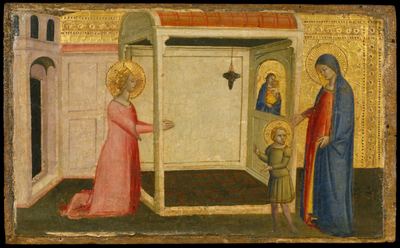
In the pictureOn the left of a wide horizontal picture, a woman in pink with a crown and halo kneels and holds out both hands. In the center is a small room with a red tiled roof and a lamp hanging from the ceiling, and in its inner doorway is a small Virgin and Child that looks like a painting. In front of the room stands a small haloed child in an olive robe, and from the right Mary, in red with a blue mantle, reaches out her hand. On the left is a pink building with arched windows, and behind is a gold wall stamped with dotted patterns. A red grid pattern covers the floor of the room.
BackgroundCatherine of Alexandria is a saint said to have been martyred in the early 4th century; her crown refers to the tradition that she was a princess. According to later legend, while praying before a picture of the Virgin and Child she met the Virgin and the infant Jesus in a vision, and afterward entered into a "mystic marriage" with Christ. The painter, whose name has not survived and who is called the Master of the Orcagnesque Misericordia, painted it in Florence around 1365–70. It measures 21×34.3 cm and appears to have been one scene in the strip beneath an altarpiece (the predella). Orcagna was the leading Florentine painter of the mid-14th century, and this painter is thought to have followed his style.
Puzzle tipThe pink robe, red roof, blue mantle and gold wall separate by color. Fit the faces and halos of Catherine, Mary and the child first, then set up the central frame with the white columns of the small room and the straight lines of the roof. The red grid on the room's floor and the hanging lamp are good reference points. Join the gold wall along its dotted bands, and fill the dark green ground last. The child's olive robe is lighter than the dark green ground, so the two can be told apart. 48 pieces work well.
- Artist
- Italian, Florence, active second half 14th century
- Classification
- Paintings
- Medium
- Tempera and gold on wood
- Dimensions
- 21 × 34.3 cm
- Credit line
- Robert Lehman Collection, 1975
Source: The Metropolitan Museum of Art ↗
Stories about this work
- Named After a Masterpiece: Florentine Painters in Orcagna's Shadow
Art historians call painters whose names are lost by nicknames taken from their key works. Four Florentine altarpiece panels by Orcagna and painters in his shadow, a 70-year record.
Puzzles to try next
More Robert Lehman Collection puzzles· Stories and puzzle tips