Named After a Masterpiece: Florentine Painters in Orcagna's Shadow
Published
“Master of the Orcagnesque Misericordia.” Too long for a person’s name, too short for a description. That is the name of the painter attached to one Florentine panel in the Robert Lehman Collection. It is also a name that shows how art historians refer to painters whose names have not come down to us. We follow four altarpiece panels over 70 years, from 1365 to 1435: by that painter, by Orcagna, who cast a shadow over him, and by painters working in the same tradition.
| Work | Painter | Date |
|---|---|---|
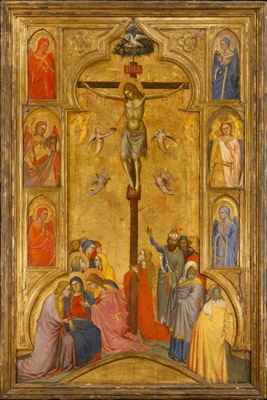
| The Crucifixion | Orcagna (Andrea di Cione) | ca. 1365 |
| The Vision of Saint Catherine of Alexandria | Master of the Orcagnesque Misericordia | ca. 1365–70 |
| The Crucified Christ between the Virgin and Saint John the Evangelist | Lorenzo Monaco | ca. 1406 |
| Saints John the Baptist and an Evangelist (Matthew?) | Bicci di Lorenzo | 1433–35 |
Florence after Giotto: Orcagna
 Solve this painting as a puzzle → about 5 minutes on Easy
The Crucifixion is the largest panel among the collection’s early Italian paintings. Andrea di Cione, known as Orcagna, led Florentine painting after Giotto and was a painter, sculptor and architect.
At the center, angels fly around Christ on the cross, catching his blood. Saints sit one to a compartment in the vertical bands on either side, and the decoration at the top even includes a pelican, a bird that became a symbol of Christ because it was believed to feed its young with its own blood. The composition, gathering all of this into one picture, shows the form of a 14th-century altarpiece well.
A name borrowed from a masterpiece
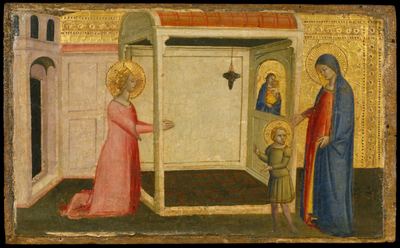
Orcagna left his name clearly on record, but another painter of the same time and the same city did not leave a single letter of his. The painter of The Vision of Saint Catherine of Alexandria is one of them.
“Master of the Orcagnesque Misericordia” is a designation taken from a key work because the painter’s name has not survived. Art historians gave this long, descriptive name on the basis of the painter’s key work, the “Misericordia” (Madonna of Mercy), and a style resembling Orcagna’s. The panel is small, 21 centimeters tall. It was probably one of several scenes lined up along the lower band (the predella) of a large altarpiece. It shows a scene from the story that Catherine of Alexandria, in a vision, entered into a mystic marriage with the Christ Child.
A devotional picture that kept its frame: Lorenzo Monaco
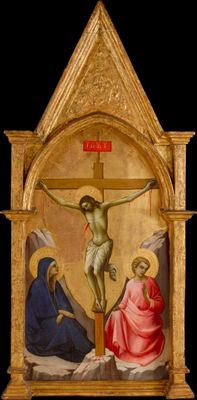
About 40 years later, Lorenzo Monaco painted The Crucified Christ between the Virgin and Saint John the Evangelist. The scene of the Virgin and John standing beneath the cross had been the most common devotional image since the Middle Ages, hung in monastery cells or on side altars of churches.
This panel’s frame is a rarity. The original survives with it, so you can see the painting as it first looked. It is uncommon for a gilded frame with a pointed gable and columns to come down intact together with its painting. The long curve of the Virgin’s cloak flowing downward is a habit of Lorenzo Monaco’s hand, and you can find the same curve in Lorenzo Monaco’s Nativity.
Altarpieces pouring out of a workshop: Bicci di Lorenzo
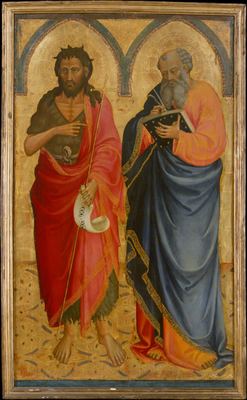
The latest, Saints John the Baptist and an Evangelist (Matthew?), was painted by Bicci di Lorenzo in 1433–35. John the Baptist is the patron saint of Florence, so he is never missing from the city’s altarpieces. Bicci di Lorenzo ran a large workshop in Florence and produced church altarpieces in great numbers in the early 15th century.
This panel was one wing of a triptych. If Orcagna was the master who led the generation after Giotto, Bicci di Lorenzo was a painter of the era when that tradition had become firmly established and large workshops turned out altarpieces almost as if stamping them out. Here you can see where Florentine painting had arrived after 70 years.
Finding your way through the gold
All four center on figures against a gold ground, but each differs in how complex it is. Orcagna’s has many elements. Set up the framework first with the vertical line of the cross and the compartment borders of the side bands, then divide the figures below into groups by their red, blue and white clothing. Fill the gold pieces starting with those that catch an angel or a halo. It is enjoyable at up to 300 pieces.
The anonymous painter’s panel splits into color zones: pink dress, blue cloak, red roof, gold wall. Fit the faces of the two women and the child first, build the central framework from the straight lines of the room, then fill in the gold and the walls. 48 pieces is about right.
For Lorenzo Monaco, build the outer framework first from the columns and pointed gable of the gilded frame. Then fit the straight lines of the cross, the blue cloak and the pink robe separately, and fill the gold ground starting with pieces that touch the halos and the cross. 100 pieces works well. In Bicci di Lorenzo’s panel, a red cloak and a blue cloak clearly divide left from right. Fit the two faces, John’s scroll and the evangelist’s book first, then join the cloaks following the direction of their folds. 100 pieces suits this one too.
A painter remembered by another’s name
Set the four side by side and a curious contrast appears. Orcagna’s name is clear, while the anonymous painter who resembled him is called only by borrowing that name. Lorenzo Monaco and Bicci di Lorenzo worked under their own names, but both stand within the Florentine altarpiece tradition that Orcagna established. One person’s name can become the means of naming another: that is how names are used in art history.
As seen in scattered altarpiece panels, predella pieces like these broke away from large altarpieces and each went its own way. The painter of “The Vision of Saint Catherine” never got a name back. Even so, that small panel, 21 centimeters tall, is remembered, if only by leaning on a master’s shadow, and it now meets the other three, separated by 70 years, again on one screen.