Under the Wave off Kanagawa (Kanagawa oki nami ura), also known as The Great Wave, from the series Thirty-six Views of Mount Fuji (Fugaku sanjūrokkei)
A giant wave raises claw-like foam over three boats while a small Mount Fuji sits far below: the most reproduced print in the world. Full commentary ↓
Couldn't load the puzzle image.
Turn on piece outlines to see piece positions on this picture too
Drag the pieces into place · When zoomed in, drag an empty spot to move around
You can also play with a keyboard — Tab to the board, thenSpace pick a piece, Arrow keys move it (with Shift for small steps),Esc deselect, R rotate a piece (Shift+R the other way)
Under the Wave off Kanagawa (Kanagawa oki nami ura), also known as The Great Wave, from the series Thirty-six Views of Mount Fuji (Fugaku sanjūrokkei) is a woodblock print by Katsushika Hokusai (ca. 1830–32) in the collection of The Metropolitan Museum of Art. It measures 25.7 × 37.9 cm.
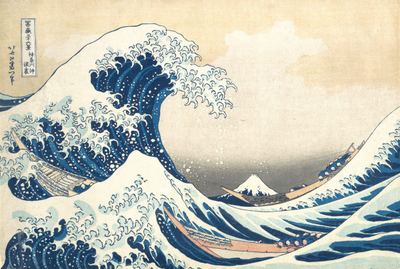
In the pictureA huge wave rising from the left of the picture breaks toward the right, its white foam reaching out like claws. Beneath it, three long, narrow boats carrying men row against the waves, and beyond the trough the wave has made, a small snow-capped Mount Fuji can be seen. The wave is a deep Prussian blue, and the sky a pale grayish tone.
BackgroundUnder the Wave off Kanagawa is the first sheet of the series Thirty-six Views of Mount Fuji, which Hokusai made in the early 1830s, at around seventy. Prussian blue pigment, then newly imported from Europe, made such a deep blue possible. As a woodblock print, the same image was printed thousands of times, and in the late 19th century it traveled to Europe, influencing Monet, Van Gogh and even Debussy. Mount Fuji drawn smaller than the wave is a play of viewpoint; the whole series is about where and how Mount Fuji can be seen.
Puzzle tipBecause it is a print, the edges between areas of color are sharp, as if cut with a knife. Join the pieces along the boundary between blue wave and white foam first to build the outline of the wave, and the rest falls into place. The sky pieces are nearly a single color, so fill them into the empty spaces last. The boats and Mount Fuji are reliable reference points.
- Artist
- Japanese, Tokyo (Edo) 1760–1849 Tokyo (Edo)
- Period
- Edo period (1615–1868)
- Culture
- Japan
- Classification
- Prints
- Medium
- Woodblock print; ink and color on paper
- Dimensions
- 25.7 x 37.9 cm
- Credit line
- H. O. Havemeyer Collection, Bequest of Mrs. H. O. Havemeyer, 1929
Source: The Metropolitan Museum of Art ↗
In these collections: Masterpieces Everyone Knows · Sea and Waterside Masterpiece Puzzles
Stories about this work
- A Wave, a Red Fuji and a Plum Branch: Three Prints by Hokusai and Hiroshige as Puzzles
Under the Wave off Kanagawa, the most reproduced print in the world; Red Fuji; and Hiroshige's plum garden, which Van Gogh copied in oil. Why woodblock prints work so well as puzzles.
- 12 Must-See Paintings at the Met in New York, Meet Them First as Puzzles
Washington Crossing the Delaware, Madame X, Bruegel's Harvesters, Vermeer and Rembrandt, Van Gogh's wheat field and Hokusai's wave. Twelve must-see paintings at the Met, how to check whether they are on view, and how to preview them as puzzles.
Puzzles to try next
More Japanese Prints & Paintings puzzles· Stories and puzzle tips