Water Lily Pond
The water lily pond and Japanese-style wooden bridge Monet built in his garden at Giverny, the setting for the water lily paintings of his last years. Full commentary ↓
Couldn't load the puzzle image.
Turn on piece outlines to see piece positions on this picture too
Drag the pieces into place · When zoomed in, drag an empty spot to move around
You can also play with a keyboard — Tab to the board, thenSpace pick a piece, Arrow keys move it (with Shift for small steps),Esc deselect, R rotate a piece (Shift+R the other way)
Water Lily Pond is an oil painting by Claude Monet (1900) in the collection of The Art Institute of Chicago. It measures 89.8 × 101 cm.
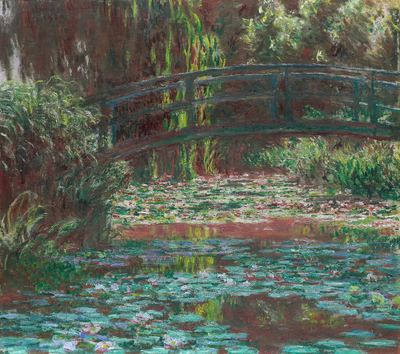
In the pictureA green wooden bridge arches across the upper part of the picture from the left edge to the right. Above the bridge, green stems like hanging branches mix with reddish-brown shade, and the upper right is covered with light green leaves in sunlight. The pond beneath the bridge is almost filled with lily pads. The band just below the bridge is thick with pink and red flowers; beneath it a single horizontal line of reddish-brown reflection passes, and at the very bottom pink and white flowers float among blue-green pads. Tall grasses and bushes close off the left edge.
BackgroundMonet lived from 1883 in Giverny, a village northwest of Paris, and in 1893 he bought land across the road in front of his house, brought in water and dug a pond. After planting water lilies and building a round Japanese-style wooden bridge, he painted several pictures of the bridge from the same spot in 1899 and 1900. This painting is the one from 1900. Monet then moved on to water lily paintings that left out the bridge and showed the water's surface up close, and he painted this pond until his death in 1926. The Art Institute of Chicago also has a much larger work of the same title from 1917–19.
Puzzle tipThe dark green curve of the bridge is the surest reference line. Join this curve first, and the picture divides into the trees above and the pond below. The pond changes color by height: a band with many pink and red flowers, the reddish-brown reflection and the blue-green pads are stacked in turn, so gather the pieces band by band. The top splits into the left side, with green stems hanging vertically, and the right side, with clustered light green leaves. Brushstrokes are spread evenly across the whole picture, so 100 pieces work well.
- Classification
- Painting
- Medium
- Oil on canvas
- Dimensions
- 89.8 × 101 cm
- Credit line
- The Art Institute of Chicago, 1933.441
Source: The Art Institute of Chicago ↗
In these collections: Masterpieces Everyone Knows · Flower Painting Puzzles
Stories about this work
- 17 Must-See Paintings at the Art Institute of Chicago, from Seurat's Dots to American Gothic
Seurat's A Sunday on La Grande Jatte, Caillebotte's Paris Street; Rainy Day, Van Gogh's The Bedroom and Grant Wood's American Gothic. The stories of 17 must-see paintings at the Art Institute of Chicago, what to check before you go, and how to meet them first as puzzles.