Wheat Field with Cypresses
Dark cypresses rise like flames beyond a golden wheat field under swirling clouds, a landscape Van Gogh loved most from his time at the Saint-Rémy asylum. Full commentary ↓
Couldn't load the puzzle image.
Turn on piece outlines to see piece positions on this picture too
Drag the pieces into place · When zoomed in, drag an empty spot to move around
You can also play with a keyboard — Tab to the board, thenSpace pick a piece, Arrow keys move it (with Shift for small steps),Esc deselect, R rotate a piece (Shift+R the other way)
Wheat Field with Cypresses is an oil painting by Vincent van Gogh (1889) in the collection of The Metropolitan Museum of Art. It measures 73.2 × 93.4 cm.
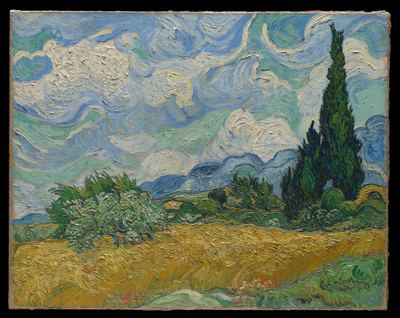
In the pictureIn the foreground a golden wheat field bends in the wind; in the middle are olive trees and shrubs; at the right two dark blue-green cypresses shoot up into the sky like flames. Behind them the violet Alpilles mountains lie low, and white clouds swirl thickly across the sky, every brushstroke visible. There is no person anywhere in the picture, and everything seems to sway in the same wind.
BackgroundVan Gogh first painted this view in the summer of 1889, looking out from the asylum at Saint-Rémy, and that autumn he painted the same composition twice more indoors. This painting is one of them, and the artist himself wrote to his brother Theo that it was "the best of my summer canvases." Cypresses are planted in the cemeteries of southern France and so call death to mind, but Van Gogh said their form was "as beautiful as an Egyptian obelisk."
Puzzle tipIn this puzzle, the direction of the brushstrokes is the clue. The wheat field is short strokes lying sideways, the cypresses are strokes shooting upward, and the clouds are strokes curling round. First sort by color into yellow (wheat), green (shrubs), blue (sky), and dark blue-green (cypresses), then within each color place pieces by stroke direction. At 300 pieces the white cloud pieces are the most confusing; tell top from bottom by the curvature of the swirls.
- Artist
- Dutch, Zundert 1853–1890 Auvers-sur-Oise
- Classification
- Paintings
- Medium
- Oil on canvas
- Dimensions
- 73.2 × 93.4 cm
- Credit line
- Purchase, The Annenberg Foundation Gift, 1993
Source: The Metropolitan Museum of Art ↗
In these collections: Masterpieces Everyone Knows
Stories about this work
- Wheat Fields, Cypresses and Sunflowers in the Met's Six Van Goghs
From a Paris self-portrait to the irises of Saint-Rémy, six paintings trace Van Gogh's last four years. Plus why the direction of the brushstrokes in each becomes a puzzle clue.
- 12 Must-See Paintings at the Met in New York, Meet Them First as Puzzles
Washington Crossing the Delaware, Madame X, Bruegel's Harvesters, Vermeer and Rembrandt, Van Gogh's wheat field and Hokusai's wave. Twelve must-see paintings at the Met, how to check whether they are on view, and how to preview them as puzzles.