Wheat Fields, Cypresses and Sunflowers in the Met's Six Van Goghs
Published
Van Gogh died at thirty-seven. Almost all the paintings of his that come to mind were made in his last four years. The six Van Goghs from The Metropolitan Museum of Art that have been turned into puzzles happen to mark those four years in order: Paris in 1887, Arles in 1888, Saint-Rémy in 1889, and 1890, just before he left the asylum. Lined up in order of time, you can see the colors growing brighter and the brushwork growing rougher.
All six are public domain works whose copyright has ended, and the puzzles are made directly from the high-resolution photographs the museum released under CC0. How such images can be used is explained in the story of public domain images.
| Work | Year | Place | Recommended pieces |
|---|---|---|---|
| Self-Portrait with a Straw Hat | 1887 | Paris | 48–100 |
| Sunflowers | 1887 | Paris | 100 |
| Oleanders | 1888 | Arles | 100–300 |
| Cypresses | 1889 | Saint-Rémy | 48–100 |
| Wheat Field with Cypresses | 1889 | Saint-Rémy | 300 |
| Irises | 1890 | Saint-Rémy | 100 |
Paris, 1887: a face painted for lack of money for a model
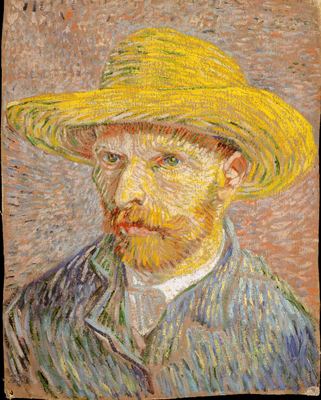 Solve this painting as a puzzle → about 5 minutes on Easy
In Self-Portrait with a Straw Hat, a red-bearded man in a yellow straw hat looks out at us, shoulders turned slightly. The face, the clothes and the background are all filled with short, dense dabs of color, so the forms scatter as you come closer and come back together as you step away.
After arriving in Paris, Van Gogh absorbed the Impressionists and Seurat’s pointillism and gave up the dark browns of his Dutch years. The problem was that he had no money to hire models. So he sat in front of a mirror and painted more than twenty self-portraits. On the back of this canvas is another painting (a woman peeling potatoes), a sign that he used both sides because he could not spare even a single canvas.
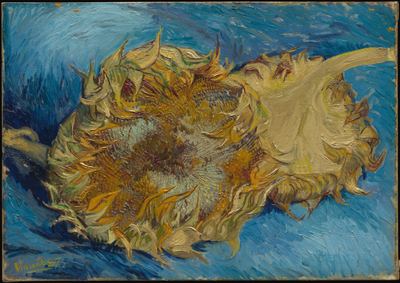
Sunflowers, painted in Paris the same year, has no vase. A few cut flower heads lie as they are on a table, and the brown centers packed with seeds take up almost the whole picture. It comes a year before the famous vases of sunflowers from Arles, and at this time Van Gogh’s eye was on the texture of the wilting flower heads themselves. There is also a record that Gauguin admired these Paris sunflowers and traded one of his own paintings for them.
Arles, 1888: a rarely bright summer
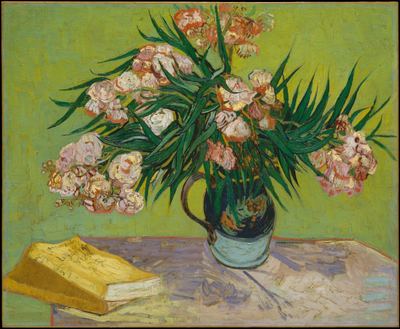
Oleanders is a still life of pink oleanders growing thick in a green earthenware vase, with two yellow-covered books lying on the table. On the spine you can see the title of Émile Zola’s novel “La Joie de vivre” (The Joy of Living). Oleanders bloom all summer in the south of France, and Van Gogh called them flowers that bloom “madly, in love.” The title of the book beside them speaks the mood of the painting for it. It was a rarely bright summer in a life known to have been dark and hard.
Saint-Rémy, 1889: trees shooting up to the sky
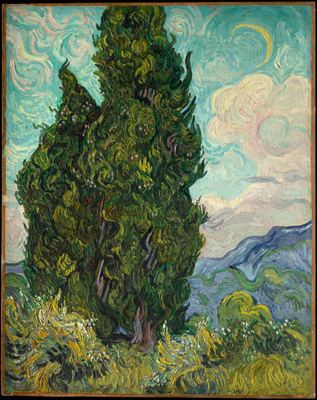
In Cypresses, painted in June 1889 just after he entered the asylum, two trees shoot up to the very top of the canvas. The branches swirl in thickly applied paint, and the crescent moon and clouds in the sky behind turn to the same beat. Van Gogh wrote in a letter that the cypresses were “always on my mind, yet no one has ever painted them the way I see them,” and he wanted to make a series of cypresses, as he had with sunflowers.
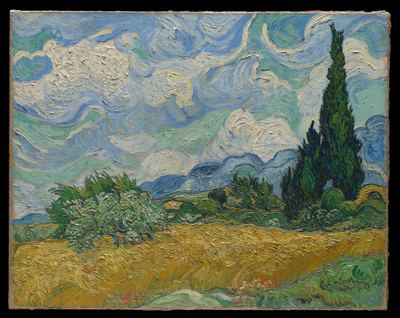
Wheat Field with Cypresses is one of the paintings he first made that summer from the view outside the asylum window, then painted twice more indoors in the autumn with the same composition. In front, a golden wheat field bends in the wind; on the right, two dark blue-green cypresses; behind, the violet Alpilles mountains; and in the sky, white clouds swirling in thick strokes. Van Gogh wrote to his brother Theo that this was “the best of my summer paintings.”
1890: a few days before leaving the asylum
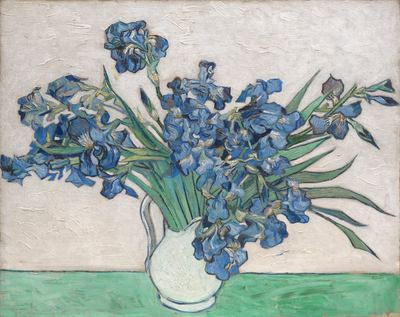
Irises is one of four still lifes painted in May 1890, a few days before he left Saint-Rémy. Purple irises fill a vase against a pale pink background on a light green table. Van Gogh described the painting as “violet irises on a pink background,” but the red paint he used then has faded over time, and the background is now much paler. The irises we see are a little paler than the ones the painter saw.
Sort by color, and when stuck, look at the brush marks
Van Gogh’s paintings usually divide clearly into three or four blocks of color, so sorting pieces by color works well. The self-portrait divides into yellow hat, flesh-toned face, blue clothes and blue-green background; Oleanders into pink, green, yellow and light green; Irises into purple, green and pale pink. At 24 to 100 pieces, color sorting alone carries you all the way through.
At 300 pieces, your hands stop where the same color covers a wide area. The second clue to bring out then is the direction of the brushstrokes. The wheat field has short strokes lying horizontally, the cypresses have strokes shooting upward, and the clouds have strokes that curl around. In the self-portrait, when the background and clothes are both blue and confusing, you can tell them apart because the background strokes scatter in every direction while the strokes on the clothes are neatly vertical. Because these are the museum’s photographs of the originals, the brush marks are fully visible when you zoom in. If you get stuck looking only at color with the image small, enlarge it and look at the texture.
Cypresses, with only two colors, green and blue, barely responds to color sorting. Instead, connect the outlines of the trees first, the border pieces where the green meets the sky. Once the outline takes shape, the inside fills in by following the direction of the swirls. The crescent moon pieces are a reference point whose location you cannot mistake.
What he found in Paris
During his Paris years, Van Gogh diligently copied Japanese prints and spent time with the Impressionist painters. You can see the kind of prints he copied in Hokusai and Hiroshige, and paintings by the artists he spent time with in the Impressionists and Paris painting after them. The dabs of Paris pass through the pink flowers of Arles and turn into the swirls of the Saint-Rémy cypresses. Putting the six together in order, you feel at your fingertips how far one person’s brush traveled in the short span of his last four years.
Frequently asked questions
Is it a copyright problem to use Van Gogh paintings as puzzles?
Van Gogh died in 1890, so the copyright on his paintings has expired, and The Metropolitan Museum of Art has released its photographs of the originals under CC0. All six puzzles on this site use those photographs as they are.
What should I do if I get stuck on a Van Gogh puzzle at 300 pieces?
You get stuck where the same color spreads over a wide area. Then look at the direction of the brushstrokes. The wheat field has strokes lying horizontally, the cypresses have strokes shooting upward, and the clouds have strokes that turn in circles. Because these are the museum's photographs of the originals, the brush marks are clearly visible when you zoom in.
Which of the six paintings is easiest to start with?
"Oleanders" and "Self-Portrait with a Straw Hat", whose colors divide clearly into four, are manageable at 24–100 pieces. "Cypresses", with only two colors, green and blue, does not respond to color sorting, so you have to connect the outlines of the trees first.