From the Annunciation to the Adoration of the Shepherds: 10 Masterpiece Puzzles for Christmas
Published
The first scene of the Christmas story has no baby in it. There is only an angel holding a lily. There are no puzzles made specially as Christmas pictures, but going through the Metropolitan Museum of Art’s collection for paintings tied to a scene from the Christmas story turned up ten. The day the angel came to Mary, the night the child was born, the shepherds stepping into the stable, and Mary holding the child. Laid out in story order, they make a good one-a-day set for the holidays.
The Story Begins Nine Months Before Christmas
In the church calendar, the Annunciation falls on March 25, nine months counted back from Christmas. That is why, if you follow the Christmas story from the beginning, the angel is the first one you meet.
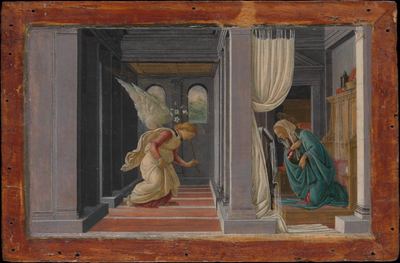 Solve this painting as a puzzle → about 5 minutes on Easy
The Annunciation is a small panel 31 cm wide that Botticelli painted around 1490. Inside a loggia, the angel Gabriel kneels holding a white lily, and Mary bows beside a curtain. With so many gray stone columns and floor tiles, it looks hard, but in practice it is not. All those straight lines converge on a single point, so how steeply a line slants tells you where the piece goes. Place the angel’s pink robe and Mary’s blue robe first, then fill in the architecture by following the direction of the lines.
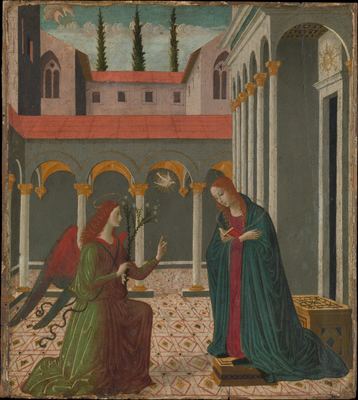
The other painting titled The Annunciation was painted by a Florentine artist in the early 1500s. His name has not come down to us, so he is known by the nickname “Maestro Esiguo.” Beyond a loggia with a red roof, a garden of cypress trees is visible, and a dove descends from the sky. Where Botticelli’s is a small, wide panel, this one is a little taller, so it takes in the garden and the sky as well. Assemble the two side by side and you can see how similarly the stage for the same scene was set. Both have the loggia, the tiled floor, and the lily.
The Same Night, Two Very Different Nativities
There are two paintings with exactly the same title, and the more you look, the less they feel like the same scene.
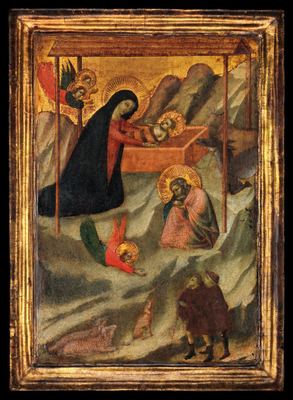
One was painted in the first half of the 14th century. On a panel 30 cm tall, a gold ground and gray rocky mountains are stacked layer upon layer, and below them the child lies in a red manger. Joseph dozes with his chin in his hand, and at the bottom are a flock of sheep and the shepherds. Because it predates perspective, space is built by piling up rocks in tiers.
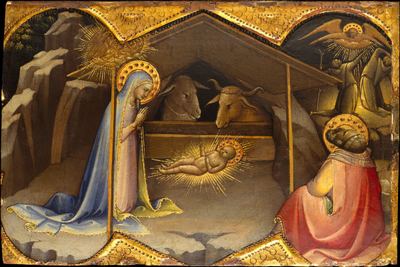
The other is a wide painting by Lorenzo Monaco from around 1406–10. A wooden stable stands among the rocks, and the child in the manger wears a halo and gives off his own light. An ox and a donkey look out from behind the manger, and up above, a small scene shows an angel bringing the news to a shepherd. The way the rocky mountains are built follows the same tradition as the first painting, but the colors are far brighter.
In a puzzle, this difference becomes a difference in difficulty. The first painting has a lot of gray rock pieces, so you have to solve them by comparing the direction of the ridges against the preview. In other words, it has wide areas that are almost a single color. In Monaco’s, the blue mantle, red robe, gold sky and brown stable divide the picture into clear zones, so even at the same piece count it is much easier.
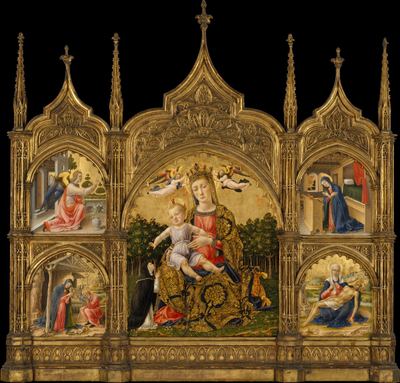
There is one more. The Madonna of Humility, the Annunciation, the Nativity, and the Pietà is a Venetian work that gathers the four scenes named in its title into a single altarpiece. The gilded frame with its pointed spires is part of the picture, so there are many frame pieces, and each compartment tells a different story. The Nativity is one of those compartments.
A Stable Lit by a Single Lantern
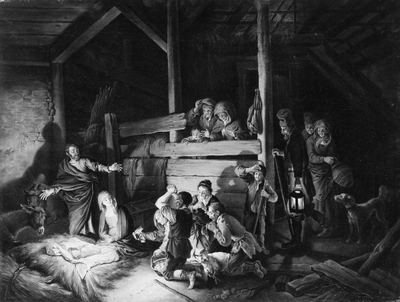
The Adoration of the Shepherds is the latest of the ten. In the 1760s the German painter Dietrich painted the child and the shepherds in a dark stable lit by a single lantern. Because the event happened at night, 17th-century Dutch painters liked to paint this scene as a night piece lit by a lantern or candle, and Dietrich carried that tradition into the 18th century.
The image available is black and white. There are no color clues at all, so you have to solve it by light and dark alone. It works better to join the bright swaddling cloth of the child, the area around the lantern, and the bright arm of the figure on the left first, and then build the upper framework from the straight pieces of the beams. Quite a few pieces are simply dark, so do not be ambitious with the piece count. Of the ten, this is the one painting I recommend at Normal or below.
A Child Lying on the Ground, a Virgin Holding the Child
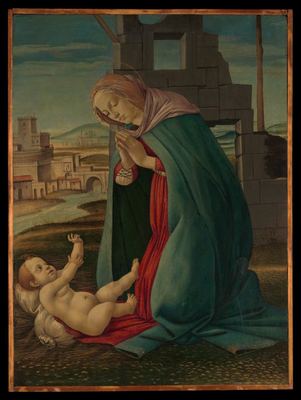
In Madonna Adoring the Child from Botticelli’s workshop, the child lies on the grass instead of in a manger. Mary kneels with her hands together and looks down at him. This format, with the child laid on the ground and adored, was hugely popular in Florence in the late 15th century. Behind them are a ruined wall and a distant city, which some read as meaning that the old era is ending and a new one is coming.
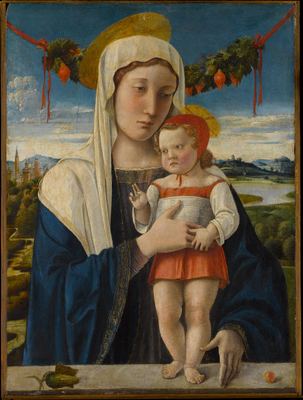
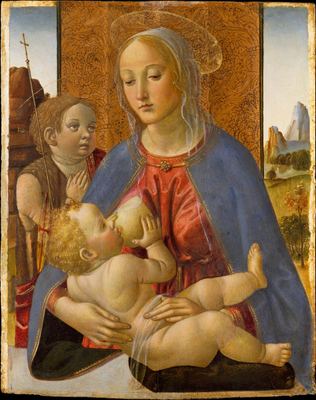
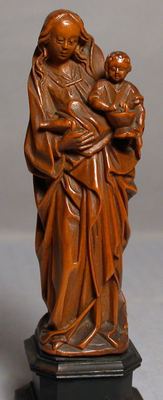
There are three paintings of the Virgin holding the Child. In Giovanni Bellini’s Madonna and Child, the blue mantle, white veil, red robe, sky and green landscape each occupy their own zone, which makes it good for sorting by color. In Cosimo Rosselli’s Madonna and Child with the Young Saint John the Baptist, the young John stands holding a cross-staff beside the Virgin as she nurses. The boxwood Statuette of the Virgin and Child, 9 cm tall, is brown all over, so it is not easy even with few pieces. How the image of the Virgin and Child changed over time is compared using these three in why there are so many Madonna and Child paintings.
How Many Pieces Is “About 24,” Really?
The difficulty says “about 24 pieces,” but because the grid is set to match the painting’s width-to-height ratio, the actual piece count differs a little from work to work. The numbers below were calculated with the engine’s formula.
| Work | Easy | Normal | Hard |
|---|---|---|---|
| The Annunciation (Botticelli) | 24 | 54 | 96 |
| The Annunciation (Maestro Esiguo) | 25 | 56 | 90 |
| The Nativity (Daddesco) | 24 | 48 | 108 |
| The Nativity (Lorenzo Monaco) | 24 | 54 | 96 |
| The Madonna of Humility altarpiece | 25 | 49 | 100 |
| The Adoration of the Shepherds | 20 | 48 | 108 |
| Madonna Adoring the Child | 24 | 48 | 108 |
| Madonna and Child (Bellini) | 20 | 48 | 108 |
| Madonna and Child (Rosselli) | 20 | 48 | 99 |
| Statuette of the Virgin and Child | 24 | 40 | 90 |
One a Day, from the Birth to the Adoration
If you are with someone trying a puzzle for the first time, choose a painting with clear colors on Easy. Bellini’s Madonna and Child or Monaco’s The Nativity are right for this. Tips for sharing one screen by taking turns, and for solving the same picture on the same day with family who live far away, are written up separately in doing a puzzle together as a family over the holidays.
If you have plenty of time on your own, following the story in order is also a good idea. Go from the Annunciation on the first day to the birth on the second and the adoration on the third, and the ten works connect into one story. You can also reopen a painting you finished on Easy at Normal. The layout is already in your head, so it feels like meeting it again with only the pieces multiplied. For the order in which to raise the difficulty, see how to choose a jigsaw puzzle difficulty.
Most of these ten belong to the same family as the gold-ground paintings of saints. That post also explains why the gold leaf gleams so brightly and why so many of the panels are tall and narrow. Fitting together, piece by piece in front of a screen on a holiday evening, gold that was laid down hundreds of years ago makes a rather nice Christmas scene.
Frequently asked questions
Are there masterpiece puzzles that are good for Christmas?
There are ten masterpieces that depict scenes from the Christmas story. They are gathered in the Christmas masterpiece puzzle collection in this order: the Annunciation, the birth of Jesus, the Adoration of the Shepherds, and the Virgin holding the Child.
Why is the Annunciation included among Christmas paintings?
In the church calendar the Annunciation falls on March 25, nine months counted back from Christmas. So if you follow the Christmas story in order, the first scene has no baby, only an angel.
Which painting is best for a first puzzle with family?
Start with one that has clear colors on Easy. Giovanni Bellini's Madonna and Child or Lorenzo Monaco's The Nativity are good choices.