How to Choose a Jigsaw Puzzle Difficulty (24 vs 48 vs 100 vs 300 Pieces)
Published · updated
Everyone who arrives at a jigsaw puzzle site for the first time has the same question: “How many pieces should I start with?” Choose by piece count alone and you will miss about half the time. The difficulty you actually feel comes from the piece count combined with the character of the picture and even the screen you are using.
The Labeled Piece Count and the Actual Piece Count
This site has four difficulty levels: Easy (about 24 pieces), Normal (about 48), Hard (about 100) and Expert (about 300). The word “about” is there for a reason. Because the grid is laid out to fit each picture’s proportions so the image is not cropped, the actual piece count goes up and down within ±25% of the label. Here is how it looks for two works with extremely different proportions.
| Difficulty | Bamboo in the Wind (tall picture) | The Defense of Champigny (wide picture) |
|---|---|---|
| Easy | 3×7 = 21 pieces | 7×4 = 28 pieces |
| Normal | 5×11 = 55 pieces | 9×5 = 45 pieces |
| Hard | 7×16 = 112 pieces | 14×8 = 112 pieces |
| Expert | 12×27 = 324 pieces | 23×13 = 299 pieces |
Both are “Normal,” yet one has 55 pieces and the other 45. The exact count appears in the “Pieces” field at the top of the screen when you open the puzzle.
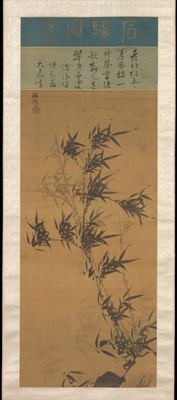
With a long, narrow picture, the count is not the only thing that differs. Open Bamboo in the Wind on Easy and there are only three columns, so 16 of the 21 pieces are edge pieces. With only five inner pieces, the border strategy works for nearly the whole picture. Even at a difficulty with the same name, the feel of solving changes this much with the aspect ratio.
How Much Color Repeats Matters More Than Piece Count
 Solve this painting as a puzzle → about 5 minutes on Easy
Even at the same 24 pieces, the difficulty you feel can be worlds apart. In Bamboo in the Wind, apart from the stretch with the bamboo, the lower part is a single sheet of amber silk, so you have to tell pieces apart by eye from tiny differences in tone. The teal title panel and the inscribed panel at the top go quickly, because each piece shows a different brushstroke shape. Difficulty varies section by section even within one work. Conversely, a picture whose colors and shapes are evenly mixed across the whole surface gives every piece clear clues, so it goes surprisingly fast even with many pieces.
So when choosing for the first time, ask these two questions before looking at the piece count.
- Are there many wide solid-colored areas, like sky or walls? → The felt difficulty rises even at the same piece count. Tips for solving pictures like this are written up separately in Strategies for Puzzles with Wide Solid Areas.
- Are figures, objects and textures spread evenly across the whole picture? → Each piece has plenty of clues, so it is relatively easy.
From Easy to Expert: When to Choose Each
| Difficulty | Pieces | When |
|---|---|---|
| Easy | about 24 | First-timers, a short break, playing with a child |
| Normal | about 48 | Once you are somewhat used to it, when you have time to finish in one sitting |
| Hard | about 100 | When you want to settle in and get absorbed |
| Expert | about 300 | When you want to dig properly into a picture with clues spread throughout, on a wide screen |
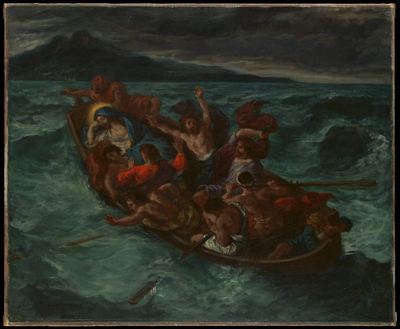
Christ Asleep during the Tempest is a dark picture, which might make it look hard, and the green sea takes up more than half the image. Still, it is not a single color. In the boat at the center, red garments, a halo and raised arms are gathered together, giving plenty of clues, and in the sea each wave has a differently shaped white crest, so each becomes a clue of its own. Piece counts for solving with children are organized by age in Your Child’s First Jigsaw Puzzle.
Up to Hard on a Phone
If you have a board in progress, the puzzle page opens at the difficulty you played most recently; otherwise it starts on Easy. Change the difficulty and that difficulty’s board opens, continuing from where you left off if there is saved progress. Saves are kept separately for each work and each difficulty, and so are completion records. On narrow screens 480px wide or less, the four difficulty buttons turn into a single dropdown.
Expert cannot be selected if the screen is 640px wide or less, or if it is a touch device 1024px wide or less. In the dropdown it stays as a disabled item with the note “On wider screens.” Lay out 300 pieces on a narrow screen and the pieces are too small to pick up with a finger. On a phone, Hard is effectively the last level.
Check Just Two Things in the Preview
Turn on the preview and look at just two things: whether near-solid areas take up more than a third of the picture, and whether the picture is extremely elongated in one direction. If the first is true, drop one level to get a feel for it; if the second is true, it may feel easier than the label, so you can go up a level. If it is a picture you have never seen, you can open it on Easy just to look over the piece shapes and the character of the picture, then move straight up. The clock starts the moment you move the first piece, so time spent looking it over does not count toward your record.
You can change the difficulty on the puzzle page at any time. Start by opening Bamboo in the Wind on Easy, and if it goes smoothly, move up one level at a time.
Frequently asked questions
How many pieces should I start with for a jigsaw puzzle?
If you are new, open Easy (about 24 pieces) to get a feel for the piece shapes and the character of the picture, and if it goes smoothly, move up one level at a time. A picture whose solid-colored areas take up more than a third of the image will feel harder at the same piece count, so start one level lower.
Why does the difficulty say "about 24 pieces"?
The grid is laid out to fit each picture's proportions so the image is not cropped, so the actual piece count varies within ±25% of the label. For the tall Bamboo in the Wind, Easy is 3×7=21 pieces; for a wide picture it is 7×4=28 pieces. The exact count appears in the "Pieces" field at the top of the screen when you open the puzzle.
Why can't I choose Expert (300 pieces) on my phone?
If the screen is 640px wide or less, or it is a touch device 1024px wide or less, laying out 300 pieces would make each piece too small to pick up with a finger. On a phone, Hard (about 100 pieces) is effectively the upper limit.
If I change the difficulty, do I lose the board I was working on?
No. Progress is saved separately for each work and each difficulty, and completion records are kept separately too. If you leave a board on Easy, open Normal, and then return to Easy, you pick up where you left off.