In What Order Do Fast Solvers Sort Their Puzzle Pieces?
Published · updated
You pick up a piece, try it in one spot and another, and when it doesn’t fit you put it down and pick up the next. That is how most people start their first puzzle. Fast solvers don’t have especially fast hands. Their order is different. If you sort first and then begin, the time it feels like it takes drops quite a bit. But just being told to “sort” doesn’t get your hands moving. You need to know what to divide, by what criteria, and in what order.
Step 1. Look at the picture before the pieces
It sounds obvious, but people skip it surprisingly often. Before touching a piece, turn on the preview and look at the picture for just 30 seconds. If you know where the faces are, how far the sky extends, and where the striking colors are, then when you pick up a piece later the thought “this goes top left” comes to you right away.
What you memorize is not the details but the zones. Divide the picture into four or five zones and give them names. “Yellowish sky,” “white wall,” “blue uniforms” is enough. Dotted lines showing the piece cells for the current difficulty are overlaid on the preview. When one axis has more than 9 cells, the lines are not drawn for every cell but sparsely, every two or more cells. So at Hard and above, use them to estimate roughly how big a zone is rather than to count cells one by one.
Step 2. Sort into three piles
There are three piles. Edge pieces, with one flat side. Color blocks, whose colors are clearly distinct, such as sky, faces, or particular objects. And ambiguous leftovers, like background texture or shadows, where it’s unclear where they belong. Even this much sorting makes it clear what you are looking for at the moment. Leave the ambiguous leftovers alone and push them to one side. As discussed in pictures with wide solid areas, these are pieces that only resolve once the surroundings are filled in.
Use the criteria that take the least judgment first. Whether a piece has a flat side is a yes-or-no question you can answer at a glance. Next is brightness. Dark, medium, or light is easier than judging hue, and a wrong call costs less. Hue comes after that, and brushstroke direction or texture comes last. The further down the list, the more you apply it only within piles that have already shrunk.
Leave the shape of tabs and blanks out of your criteria. With a physical puzzle, shape can be a clue too, but in the puzzles here tabs and blanks repeat in a regular pattern, so many pieces share the same shape. That is why pieces don’t snap together just because their shapes fit; only pieces that are actually neighbors in the finished picture join. A wrong piece won’t join even if its shape fits.
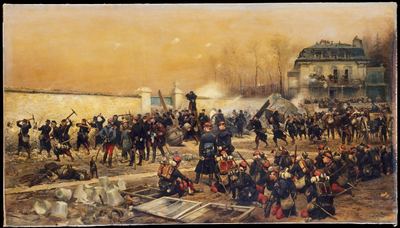 Solve this painting as a puzzle → about 5 minutes on Easy
Say you open The Defense of Champigny at Hard (14×8, 112 pieces). The top three or so rows are a sky of yellowish smoke. There is a white wall on the left and a mansion on the right, and along the bottom soldiers in blue coats and red trousers stand in rows. One pass by brightness separates the sky and wall on one side from the uniforms and ground on the other. Divide again by hue within those, and you have four or five piles. As you’ll find when you try it, once you have more than six or seven piles, the time spent deciding which pile a piece goes in tends to exceed the time sorting saves.
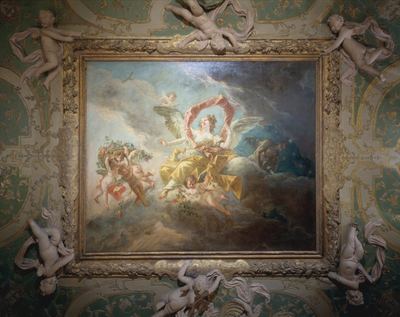
A painting photographed together with its frame divides into layers from the start. Dawn is a painting set into a bedroom ceiling, so the green wall decoration, the gold frame with its white plaster figures, and the sky painting inside each become a separate pile. The inner painting has a clear color contrast between sky and figures, so divide it once more into bright clouds, red drapery, and dark sky.
Step 3. Finish one small area
Don’t try to fill everything at once. Pick one color block and finish just that area. Completing an area is satisfying, and the remaining pieces shrink noticeably, which makes it easier to concentrate on the next area. For your first area, choose one with few pieces and a clear boundary with the areas next to it.
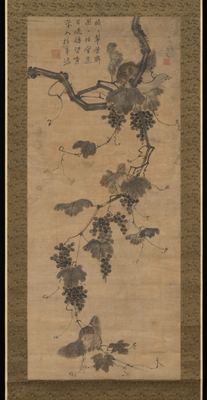
In a picture like Grapevine and Squirrels, where the subjects are scattered here and there, dividing the areas by subject makes things much easier. The bunches of grapes in the darkest ink, the leaves, the thick vine line running vertically, the inscription and squirrel at upper left. Each of these is one area.
You don’t have to move a finished area onto the board cells. Clusters joined outside the board also count toward completion, so you can move them after you finish an area.
Use the screen instead of a wide table
Sorting a paper puzzle by color takes plenty of room on the table. Online, you can zoom the screen in up to 3 times and back out, and gather pieces wherever you like for a while. At difficulties with many pieces, the workspace can become larger than the screen; just zoom out or drag an empty spot to look around. Details are in sorting pieces by color.
Once sorting becomes a habit, you may also start to question the common belief that “starting with the border is faster.” Whether that is really so is examined in Is starting with the border always faster? In the end, deciding on an order means looking at the picture one more time before you pick up a piece.
Frequently asked questions
In what order should I sort puzzle pieces?
Use the preview to divide the picture into four or five zones, then sort the pieces into three piles: edge pieces, distinct color blocks, and ambiguous leftovers. Then complete the small areas one at a time.
Can I sort by piece shape (tabs and blanks)?
We don't recommend it on this site. Tabs and blanks repeat in a regular pattern, so many pieces share the same shape. Sorting by whether a piece has a flat side, and by brightness, is faster.
Do I have to move assembled clusters onto the board?
No. Clusters joined outside the board also count toward completion, so you can move them after you finish an area.