Always Start with the Border? Paintings Where the Edge Strategy Works and Where It Doesn't
Published · updated
“Start with the border.” Most people have heard this at some point. It is not wrong, but it does not fit every painting either. Even before talking about the pictures, the piece count alone changes how much this strategy is worth.
The more pieces, the smaller the border’s share
In a grid a pieces wide and b pieces tall, there are 2×(a+b)−4 border pieces. Open Still Life with Silver at the four difficulty levels and it breaks down like this.
| Difficulty | Grid | Total pieces | Border pieces |
|---|---|---|---|
| Easy | 4×6 | 24 | 16 (two thirds) |
| Normal | 6×8 | 48 | 24 (half) |
| Hard | 8×11 | 88 | 34 (about 39%) |
| Expert | 15×21 | 315 | 68 (about 22%) |
Hard, described as “about 100 pieces,” comes out to 88 here because the grid is set to match the painting’s proportions. The exact count appears in the pieces field on the puzzle screen.
On Easy, once the 16 border pieces are done, only 8 remain. At this size, doing the border first means solving two thirds of the puzzle first, so it makes little difference where you start. Where you start begins to decide your time from Hard upward. On Expert, even after all 68 border pieces are done, 247 remain.
In a physical puzzle, the border also sets the size and outline of the board. On this site, the outline of the finished board and the cell dividers are drawn on the canvas from the start, so that job is already done. The only advantage left is narrowing down candidates. Pieces cannot be rotated, so a piece with a flat side on top belongs to the top edge, and one with a flat side on the left belongs to the left edge. There are only four corner pieces with two flat sides. There is no feature that filters out only the border pieces, so you have to scan the pieces scattered around the board by eye and pick them out.
It works well when each side shows something different
 Solve this painting as a puzzle → about 5 minutes on Easy
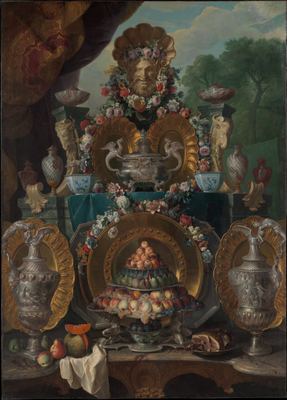
Still Life with Silver is a painting of silver dishes and fruit stacked in layers, and each of its edges has a distinct character. At the upper left is a red curtain with a gold pattern, at the upper right are sky and leaves, and along the bottom are the brown edge of a table and a white cloth. Pick out the flat-edged pieces, then sort them once more into curtain, sky and table, and the ring splits into three sections. In each section, only five or six pieces need to find their place. This is a painting where the border strategy earns its keep.
If the edges are forest, set it aside
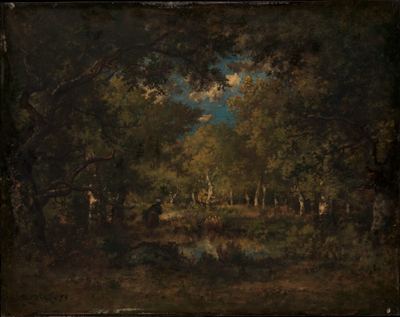
The Forest of Fontainebleau is 5×4, 20 pieces, on Easy. Picking out the 14 border pieces with flat sides is easy. The trouble comes next. The edges of the picture are almost entirely black foliage, so all 14 are similarly dark, and there is no clue telling you which side or which position they belong to. The leaf shapes do not tell you whether neighbors fit, either, so you have no choice but to try them one at a time.
In a case like this, sorting by blocks of color first is much faster. For this painting, take the blue sky showing through the leaves, the pale tree trunks and the small figure in the middle first, then expand outward. When those growing blocks reach the edge, the border pieces find their places on their own.
When black cloth takes up the whole border
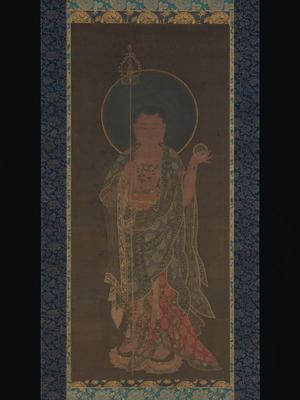
Kshitigarbha is a photograph of a tall hanging scroll laid on a black background. As a result, the left and right edges are black cloth, not painting. On Hard (9×12, 108 pieces), the outermost two columns on the left and right, 24 pieces, are almost pure black, and they make up most of the 38 border pieces. Their flat sides make them easy to pick out, but not one can be told apart by color. The tabs and blanks also repeat in a regular pattern, so they narrow the candidates only a little.
If you start with the border here, the first thing you take on is the 24 pieces with the fewest clues. Complete the information-rich areas first, such as the blue silk mounting, the halo outlined in gold and the red skirt, and fill in the black pieces last in whatever spaces remain. It is the same principle as handling solid areas of color.
One lap around the four sides before you start
Turn on the preview and trace once around the four sides of the painting. If each side differs in color or subject, start with the border; if all four sides continue in the same texture, start with blocks of color. Think twice about a painting whose edges end in a black background or blank margin. The ring may come together quickly but give you no clues about the picture itself, so it is good to plan on starting from the inside as well. This one judgment changes the direction of your first five minutes. Five habits that shorten your solving time also come down, in the end, to how you spend those first few minutes.
“Start with the border” is less a rule than an experience that has held for most paintings. If a painting is shaped differently from that experience, you do not have to follow it.
Frequently asked questions
Is it always faster to start a puzzle with the border?
No. If the four sides differ in color or subject, starting with the border is faster, but if the edges all share the same texture, like a dark forest or a black background, the border pieces become the pieces with the fewest clues. In that case it is better to start with blocks of color and fill in the border last.
What percentage of the pieces are border pieces?
In a grid a pieces wide and b pieces tall, there are 2×(a+b)−4 border pieces. Easy (4×6) has 16 of 24 pieces on the border, two thirds, while Expert (15×21) has 68 of 315, about 22%. The more pieces there are, the smaller the border's share.
Do I not need to do the border first in an online puzzle?
The job the border does in a physical puzzle, "fixing the size and outline of the board," is already done on this site, because the outline of the finished board and the cell dividers are drawn on the canvas from the start. The only advantage left is narrowing down candidates, so you can decide based on the painting.