Amitabha and Kshitigarba
Amitabha Buddha and the bodhisattva Kshitigarbha standing side by side, a rare pairing in Goryeo-dynasty Buddhist painting, on silk, first half of the 14th century. Full commentary ↓
Couldn't load the puzzle image.
Turn on piece outlines to see piece positions on this picture too
Drag the pieces into place · When zoomed in, drag an empty spot to move around
You can also play with a keyboard — Tab to the board, thenSpace pick a piece, Arrow keys move it (with Shift for small steps),Esc deselect, R rotate a piece (Shift+R the other way)
Amitabha and Kshitigarba is a painting by an unknown maker (first half of the 14th century) in the collection of The Metropolitan Museum of Art. It measures 94.6 × 55.6 cm.
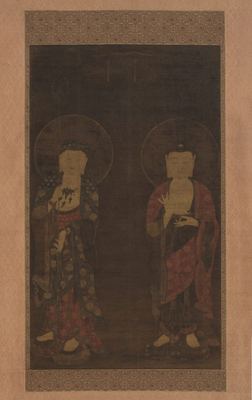
In the pictureTwo holy figures stand side by side on a dark silk ground. On the right is Amitabha Buddha in a red robe, raising a hand as he preaches; on the left is Kshitigarbha, with a shaven head and an ornate robe. Round halos still show faintly behind both figures, and the gold patterns on their robes still gleam in places despite the years.
BackgroundAmitabha is the Buddha of the Western Paradise, and Kshitigarbha is the bodhisattva who vowed to save beings even from hell. In Goryeo Buddhist painting, Amitabha is usually shown with the bodhisattvas Avalokiteshvara and Mahasthamaprapta, so a composition pairing him alone with Kshitigarbha is rare. Placing Amitabha, who leads the dead to paradise, and Kshitigarbha, who rescues them from hell, in one picture reads as a prayer for the deceased.
Puzzle tipBecause the background is nearly black, the outlines of the two figures are the only clues. Gather the pieces with the faces and hands, the red robe, and Kshitigarbha's ornate robe patterns first, then sort the black pieces by looking for those crossed by the faint circles of the halos. 48 or 100 pieces works well.
- Period
- Goryeo dynasty (918–1392)
- Culture
- Korea
- Classification
- Paintings
- Medium
- Hanging scroll; ink and color on silk
- Dimensions
- 94.6 × 55.6 cm
- Credit line
- Rogers Fund, 1913
Source: The Metropolitan Museum of Art ↗
Stories about this work
- The Gold Lines of Goryeo Buddhist Paintings Only Appear When You Zoom In
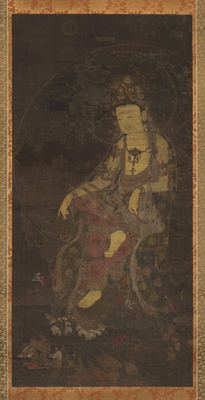
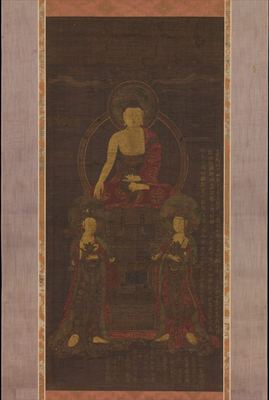
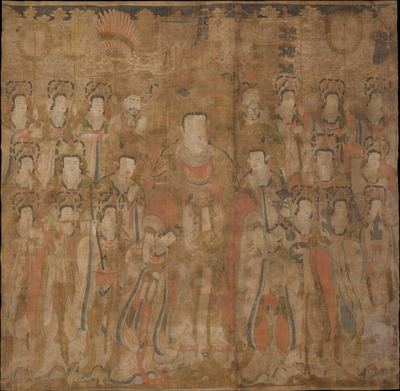
Goryeo Buddhist paintings are exquisite down to each fine gold line. We assemble four from the Met, including Water-moon Avalokiteshvara, telling them apart by what the figures hold and how their robes are rendered.