The Gold Lines of Goryeo Buddhist Paintings Only Appear When You Zoom In
Published · updated
A gold line finer than a hair flows along the hem of the bodhisattva Avalokiteshvara’s robe. It is a line you can barely see even after zooming the puzzle screen all the way in. The four Buddhist paintings of the Goryeo dynasty in the Korean Paintings category are very different in character from literati paintings or portraits, so they deserve to be discussed separately. All were painted on silk around the 14th century and entered the collection of The Metropolitan Museum of Art in the 1910s and 1920s. For all four, the painter’s name has not survived.
Lines finer than a hair, drawn in gold paint
Only about 160 Goryeo Buddhist paintings are known to survive worldwide. Most are in Japan, and the ones in Korea can be counted on one hand. But the reason art history ranks Goryeo Buddhist painting so highly is less its rarity than the precision of its rendering.
 Solve this painting as a puzzle → about 5 minutes on Easy
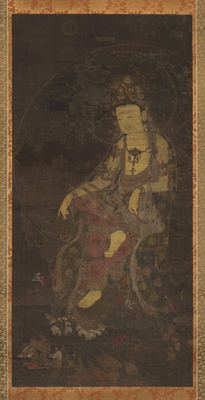
At the heart of that precision are lines drawn in geumni (gold paint). In this technique, gold powder is mixed with animal glue and applied with a brush, and every pattern on the robes was put in with lines finer than a hair. Zoom in on Water-moon Avalokiteshvara and you can see white lines and gold decoration remaining on the thin, see-through fabric. There is one more painting with the same name, and even the museum’s description of materials differs. The first is “ink and color on silk,” the second “ink, color, and gold.” The second also has a larger, clearer circle for its halo, and more of its gold paint survives.
Transparent robes colored from behind the silk
The most famous feature of the Water-moon Avalokiteshvara paintings is the transparent gauze the bodhisattva wears. A thin silk covers the body, painted so that the skin and the patterns of the garments beneath show through.
The secret is baechae (back-coloring), a method of applying color to the back of the silk. Color was painted from behind, and then patterns in gold line were laid on the front. The color seeping through from behind becomes soft, and only the gold lines on top stay sharp. One explanation holds that because the color was supported from the back, it has survived for nearly 700 years.
Telling the four apart by what they hold
The four paintings look similar at first glance, but you can tell them apart by what the bodhisattvas hold and how their heads look. In Water-moon Avalokiteshvara, the bodhisattva sits on a rock with one knee raised, a large round halo behind and a water vessel holding a willow branch beside. The small figure at lower left is Sudhana, the youth who set out on the path of seeking in the Avatamsaka (Flower Garland) Sutra. Avalokiteshvara wears an ornate jeweled crown on the head.
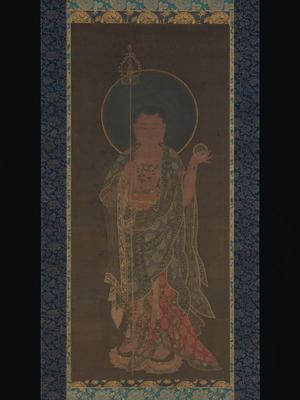
Kshitigarbha, by contrast, has a shaved head. In the left hand is a transparent jewel, and in the right a long staff with rings (a monk’s staff). The staff is a tool that opens the gates of hell, and the jewel lights up the darkness. He is the bodhisattva who vowed to save all beings, even those in hell, in the age without a Buddha, so these two objects always accompany him.
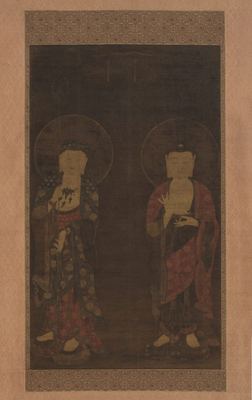
Amitabha and Kshitigarba is a rare composition with two figures standing side by side. The one in a red robe, raising a hand to preach, is Amitabha, the Buddha of the Pure Land, and the one with the shaved head is Kshitigarbha. In Goryeo Buddhist painting, Amitabha is usually painted with the bodhisattvas Avalokiteshvara and Mahasthamaprapta, so a picture of him standing alone with Kshitigarbha is rare. Since it enshrines in one picture the Buddha who leads souls to paradise and the bodhisattva who rescues them from hell, it reads as a prayer for the dead.
Assemble several of them one after another, and you can see that there were set norms for poses and robe patterns, and that within them each painter made slightly different choices. Buddhist paintings other than images of bodhisattvas, such as portraits of eminent monks and hand-copied sutras, continue in paintings that are not the face of the Buddha.
Finding the gold lines first in a dark, repetitive picture
Honestly, these are not easy puzzles. Over time the silk has turned brown, and the original tones were deep as well, so the contrast between pieces is weak. The lotus and scrolling-vine patterns on the robes repeat regularly, which brings difficulties similar to the Islamic costume puzzles. A single large figure takes up most of the picture, which also makes it hard to find reference points in the background.
Still, there is a method that works: find where the gold lines are concentrated first. Places where ornaments gather, like the jeweled crown, necklaces and bracelets, are almost the only bright and complex areas in the picture, so they catch the eye quickly. Use them as an axis and expand outward.
The other clues differ from picture to picture. In Water-moon Avalokiteshvara, the key is the pieces crossed by the red skirt, the face and the round outline of the halo. Kshitigarbha is tall, so the long straight line of the staff and the pieces of the red and green robe are the clues, and the pieces of the blue mounting (the silk border of the scroll) are on the edge, so you can frame them first. For Amitabha and Kshitigarba, assemble the faces, hands and red robe first, and among the dark pieces, look first for the ones crossed by the faint circle of the halo. It is better to start at 24 or 48 pieces and raise the count once the picture is familiar. Even within Korean painting, works of the Joseon dynasty have a different grain, and those are covered in traditional Korean art through Joseon-dynasty paintings.
I talked about zooming in when discussing medieval ivory carvings too, but few paintings are like Goryeo Buddhist paintings, where you cannot see even half without zooming in. Enlarge the hem of a robe with the + button and follow a single strand of gold line, and you will understand, without a word, why these paintings are treated as so precious.