Water-moon Avalokiteshvara
Avalokiteshvara seated on a rock with the youth Sudhana gazing up from below: a 14th-century Water-moon painting, a signature subject of Goryeo Buddhist art. Full commentary ↓
Couldn't load the puzzle image.
Turn on piece outlines to see piece positions on this picture too
Drag the pieces into place · When zoomed in, drag an empty spot to move around
You can also play with a keyboard — Tab to the board, thenSpace pick a piece, Arrow keys move it (with Shift for small steps),Esc deselect, R rotate a piece (Shift+R the other way)
Water-moon Avalokiteshvara is a painting by an unknown maker (first half of the 14th century) in the collection of The Metropolitan Museum of Art. It measures 114.5 × 55.6 cm.
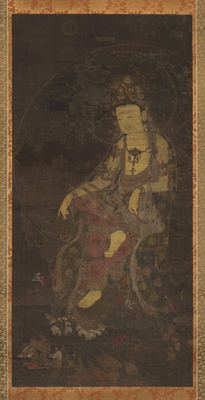
In the pictureOn a dark silk ground, Avalokiteshvara sits at ease on a rock with one knee raised. The bodhisattva wears an ornate jeweled crown and is draped in a thin, transparent cloth, and the red skirt and gold ornaments glow softly out of the darkness. At lower left a small figure stands facing the bodhisattva.
BackgroundWater-moon Avalokiteshvara paintings show the scene from the Avatamsaka (Flower Garland) Sutra in which the youth Sudhana (Seonjae), setting out on his quest for enlightenment, meets Avalokiteshvara on Mount Potalaka by the southern sea. It was an especially beloved subject in the Goryeo dynasty (Korean kingdom), and the large round halo behind the bodhisattva, the water vessel holding a willow branch placed nearby, and the water and rocks below recur almost like fixed elements. This painting dates from the first half of the 14th century; the ground has darkened with age, but the white lines of the thin cloth and the gold decoration are still alive.
Puzzle tipBecause the background is nearly black, it is hard to solve by color. Fit the bodhisattva's red skirt, the light areas of the face and hands, and the decoration of the crown first, and among the dark pieces look first for the ones crossed by the round outline of the halo. It is better to start with 24 or 48 pieces and raise the piece count once you are familiar with the picture.
- Period
- Goryeo dynasty (918–1392)
- Culture
- Korea
- Classification
- Paintings
- Medium
- Hanging scroll; ink and color on silk
- Dimensions
- 114.5 × 55.6 cm
- Credit line
- Charles Stewart Smith Collection, Gift of Mrs. Charles Stewart Smith, Charles Stewart Smith Jr., and Howard Caswell Smith, in memory of Charles Stewart Smith, 1914
Source: The Metropolitan Museum of Art ↗
Stories about this work
- Why a Painting Looks Different Once You Solve It as a Puzzle
A painting you pass in 30 seconds at a museum holds you for 30 minutes as a puzzle. How the pieces catch your eye, and what puzzle viewing cannot do for you.
- The Gold Lines of Goryeo Buddhist Paintings Only Appear When You Zoom In
Goryeo Buddhist paintings are exquisite down to each fine gold line. We assemble four from the Met, including Water-moon Avalokiteshvara, telling them apart by what the figures hold and how their robes are rendered.
- What "Unknown Artist" Means, How It Is Written in English, and Why 149 Met Works Have No Name
"Unknown artist" means the maker of a work is not known or was never recorded. Here is how the Korean terms jakga misang and jakja misang differ, the English labels (Unknown, Anonymous, Attributed to), and examples from 149 museum works.