Angarkha
An 18th-century Indian angarkha of ivory cotton, finely quilted in narrow lines, crossing diagonally over the chest and tied with a single cord. Full commentary ↓
Couldn't load the puzzle image.
Turn on piece outlines to see piece positions on this picture too
Drag the pieces into place · When zoomed in, drag an empty spot to move around
You can also play with a keyboard — Tab to the board, thenSpace pick a piece, Arrow keys move it (with Shift for small steps),Esc deselect, R rotate a piece (Shift+R the other way)
Angarkha is a textile by an unknown maker (18th century) in the collection of The Metropolitan Museum of Art.
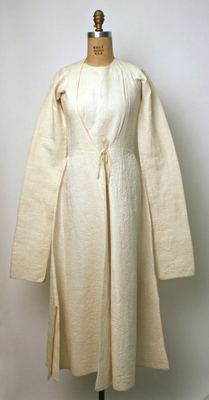
In the pictureA long coat of ivory cotton is dressed on a mannequin. One front panel crosses the chest diagonally and is tied with a single cord at the lower center; below the waist the coat flares wide, with slits at the sides. The sleeves are narrow and hang well past the fingertips. The body and sleeves are densely lined with vertical quilting, and on the lower sleeves and skirt the quilting raises flower-shaped patterns, so the design shows even without color. The neckline is round with no collar, and the cuffs and hem end in the quilted cloth itself, with no separate binding.
BackgroundThe Met's record classifies this garment as an 18th-century coat made in India, 132.1cm high and 200.7cm wide with the sleeves spread. It is quilted cotton, purchased in 1976 with funds from the Irene Lewisohn and Alice L. Crowley Bequest. It is well documented, with twelve additional photographs available. Quilting, with padding stitched between layers of cloth, helps keep warmth in and hold shape, so it may have been worn in the cool season. Unlike the other angarkha on this site (86136), which is silk woven with metallic thread, this one leaves its decoration entirely to the stitching.
Puzzle tipBeing nearly a single color, it is one of the harder puzzles on this site. Build the outline first from the boundary between the background and the ivory garment, the brass finial and the mannequin's neck, and the black stand at the bottom. Use the diagonal closing line, the central cord, and the ends of the two long hanging sleeves as reference points, and sort the rest by whether the quilting runs in vertical lines or flower patterns. The shadows of the slits at the hem also show where the bottom is. 24 or 48 pieces is recommended.
- Classification
- Main dress-Menswear
- Medium
- Cotton; quilted
- Dimensions
- Overall:
- Credit line
- Purchase, Irene Lewisohn and Alice L. Crowley Bequests, 1976
Source: The Metropolitan Museum of Art ↗
Stories about this work
- Angarkha, Choga, and Kurta: Embroidery and Weaving in Indian Menswear
The kurta is a long shirt worn across South Asia, the angarkha a robe that fastens diagonally across the chest, the choga a loose open-front robe. Nine 18th–19th century garments at the Met show the differences and the embroidery.