Antibes
Old stone houses and a tall square tower above a curving rampart, with the Mediterranean and snowy peaks beyond: Burgy's watercolor of Antibes, February 1882. Full commentary ↓
Couldn't load the puzzle image.
Turn on piece outlines to see piece positions on this picture too
Drag the pieces into place · When zoomed in, drag an empty spot to move around
You can also play with a keyboard — Tab to the board, thenSpace pick a piece, Arrow keys move it (with Shift for small steps),Esc deselect, R rotate a piece (Shift+R the other way)
Antibes is a watercolor by Henry Victor Burgy (1882) in the collection of The Metropolitan Museum of Art. It measures 32.4 × 24.5 cm.
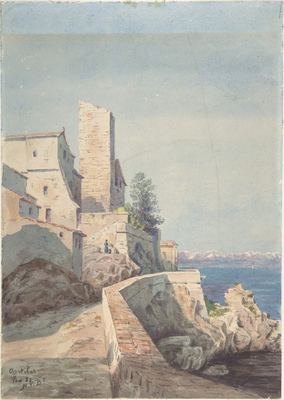
In the pictureOn the left, cream-colored stone houses and a tall square tower with an obliquely cut top stand on the rocks, and a single pine rises beside the tower. A rampart walk capped with red brick bends from the lower left toward the right and runs out toward the sea, with a rugged rocky shore below it. On the right, beyond the deep blue sea, a range of snow-covered mountains stretches out in white. A small figure stands on the rocks below the houses, and at the lower left is the inscription 'Antibes Fev 82 H.V.B.' At the very top of the sky is a horizontal band of a slightly different color.
BackgroundAntibes is an old port town between Nice and Cannes, known for its seafront ramparts and the view of the Alps beyond them. Going by the inscription, Burgy stopped here in February 1882, about a month after painting La Bocca, west of Cannes. Since it was winter, the snow on the distant mountains is distinct, and unlike in La Bocca, he signed only with his initials, H.V.B. The seaside castle in the old town of Antibes became a museum after Picasso used it as a studio in the mid-20th century. It measures 32.4 × 24.5 cm: he used a sheet of the same length as La Bocca (24.1 × 32.4 cm), this time turned upright.
Puzzle tipThe buildings and tower on the left are cream, the right side is blue sea and white mountains, and the upper half is pale sky. Fit the straight edges of the tower and the curving line of the red-brick rampart first, then place the horizon pieces, where sea meets mountains, in the middle right. The rocky shore at the lower right stands out in shadowed gray-brown. Fill the broad sky from its paler lower part, and fit the band pieces at the very top last. 48 pieces works well.
- Artist
- French, died 1901
- Classification
- Drawings
- Medium
- watercolor
- Dimensions
- 32.4 x 24.5cm
- Credit line
- Bequest of H.V. Burgy, 1901
Source: The Metropolitan Museum of Art ↗
In these collections: Winter Masterpiece Puzzles
Stories about this work
- Three French Watercolors by Burgy, Who Recorded His Travels with a Brush
A beach near Cannes, the ramparts of Antibes, an old château in the Charente. Three watercolor landscapes left by the little-known Burgy as he traveled 19th-century France.