Five Masterpieces by Vermeer, Rembrandt and Bruegel as Jigsaw Puzzles
Published
Seventeenth-century Dutch painting tends to bring to mind a single face catching the light in the darkness. That is Rembrandt’s way. Vermeer, working in Delft at the same time, did the opposite and painted rooms with white walls full of morning sunlight. Bruegel, a century earlier, went right outside and painted farmers eating lunch in a wheat field. Gather these five works from The Metropolitan Museum of Art and you feel how broad the phrase “Dutch painting” really is. As puzzles, too, the three painters each call for a different approach.
| Work | Artist | Year | Puzzle features |
|---|---|---|---|
| The Harvesters | Pieter Bruegel | 1565 | Many clues, so even 300 pieces is manageable |
| Young Woman with a Water Pitcher | Johannes Vermeer | ca. 1662 | Large white wall |
| Study of a Young Woman | Johannes Vermeer | ca. 1665–67 | Half black background |
| Aristotle with a Bust of Homer | Rembrandt | 1653 | More than half darkness |
| Self-Portrait | Rembrandt | 1660 | All brown except the face |
Bruegel’s August: lunch in the shade of a pear tree
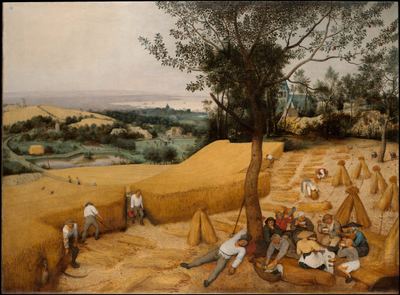 Solve this painting as a puzzle → about 5 minutes on Easy
In The Harvesters, farmers eat bread and porridge in the shade of a large pear tree, and one man sleeps with his legs stretched out. On the left, people cut wheat with scythes and tie it into sheaves, and beyond them a village and church, a green valley and even a sea with ships stretch far into the distance.
It is the August painting from a series of the twelve months commissioned in 1565 by a wealthy Antwerp merchant. Only five paintings from the series survive, scattered among Vienna, Prague and New York. Because they are counted among the first paintings to take the seasons and farm work themselves as their subject, rather than the Bible or mythology, they are often called the starting point of Western landscape painting. It is something like a distant ancestor of the paintings gathered in the landscape puzzle guide.
Of the five, it is also the gentlest as a puzzle. The yellow wheat field is large, but there are people and sheaves throughout, giving you plenty to hold on to. Complete the tree and the group of figures in the foreground first, then divide the wheat field into the part already cut (pale stubble) and the part still standing (deep yellow), and even 300 pieces is worth trying.
Vermeer’s morning where nothing happens
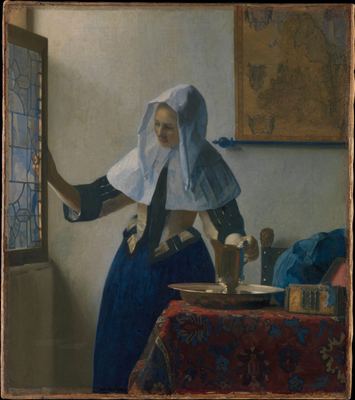
In Young Woman with a Water Pitcher, a woman in a white headcloth opens a window with one hand and holds a gold pitcher on the table with the other. There is no real event. It is an ordinary moment of opening the window in the morning before washing up. Light coming through the window on the left shines through the headcloth and casts soft shadows on the wall. Vermeer left only thirty-some paintings in his lifetime, five of which are at the Met, and this one is known as the first Vermeer to come to the United States.
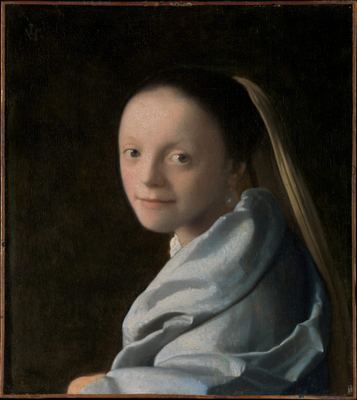
In Study of a Young Woman, a young woman against a black background turns to look over her shoulder toward us. A pearl earring hangs from her ear. The composition is almost the same as Girl with a Pearl Earring in The Hague. It is the kind of painting the Dutch of the time called a “tronie,” a picture of a face studying expression and costume rather than a portrait of a specific person. The model is unknown, and one theory holds that she was Vermeer’s daughter. The charm of this painting is how beautifully it renders a face that is not a conventional beauty.
In both works, a white wall or a black background takes up a large share of the picture. Still, there are clues. The white wall is brighter on the window side and darkens toward the right, so you can find horizontal position by brightness. The black background of Study of a Young Woman is also slightly lighter near the figure if you zoom in. For the Vermeers, 100 pieces is about right.
Rembrandt: two faces in the dark
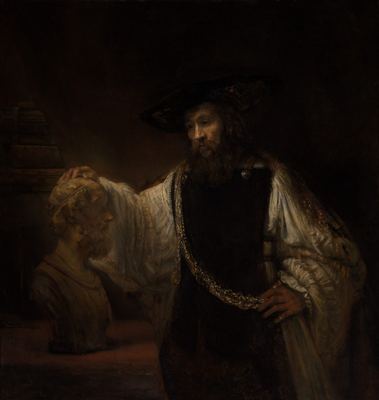
In Aristotle with a Bust of Homer, a man in a broad hat with a white sleeve showing rests his hand on the head of a marble bust in the darkness. A gold chain hangs from his shoulder to his waist, and the bust is of the blind poet Homer. The man’s eyes look into space rather than at the bust. The painting was commissioned in 1653 by a Sicilian nobleman, and the chain and medal are read as a gift from his pupil Alexander the Great. Some interpret it as a philosopher lost in thought between worldly wealth and honor (the chain) and timeless poetry (Homer), and others as Rembrandt himself, pressed by commissions. In 1961 the Met bought it for what was then the highest price ever paid for an artwork at auction, and it made the news.
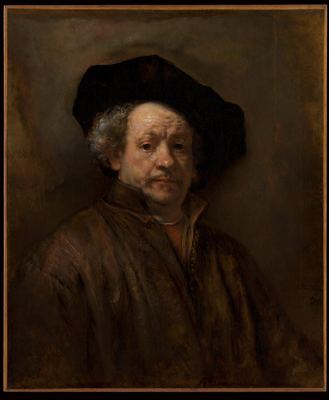
Rembrandt painted the Self-Portrait in 1660, at the age of fifty-four. Four years earlier he had gone bankrupt and sold his house and collection, and he had already lost his wife and several of his children. A wrinkled face, sagging cheeks, a red nose. He painted close to 80 self-portraits in his lifetime. When young, he dressed himself up in fine clothes and expressions; late in life, he painted himself as he was, like this. There is also a self-portrait thought to have been painted in 1655 by one of Rembrandt’s pupils, so seen alongside the post comparing two self-portraits, it shows how differently master and pupil looked at themselves.
In both Rembrandts, more than half the picture is brown darkness, so you can’t sort the pieces by color. Order is everything. Join the bright pieces with clear shapes first, such as the face, the white sleeve and the gold chain, to build up the figure, then put the dark pieces in last, filling the gaps as described in the solid background strategy. Even the darkness has small amounts of brown, black and reddish tones mixed in, so comparing with the preview on lets you tell them apart. In the self-portrait, the texture of the brushwork differs from piece to piece when you zoom in, and that becomes the final clue.
If it’s your first time, start Rembrandt at 24 to 48 pieces. If you want to do a dark portrait at 100 pieces or more, it helps to read the tips in the portrait puzzle guide first. Bruegel out of doors, Vermeer by the window, Rembrandt in the dark. Where the light falls differs from painting to painting, and that light decides which pieces you pick up first.
Frequently asked questions
Why are dark pieces the problem in Rembrandt puzzles?
More than half of each painting is brown darkness, so you can't sort pieces by color. Join the bright pieces such as the face, the white sleeve and the gold chain first to complete the figure, then fill in the dark pieces last with the preview on, using subtle differences in brown, black and reddish tones. If it's your first time, 24 to 48 pieces is recommended.
How many works by Vermeer survive?
He left only thirty-some paintings in his lifetime, and five of them are at The Metropolitan Museum of Art. Young Woman with a Water Pitcher is known as the first Vermeer to come to the United States.
Why is The Harvesters called a starting point for landscape painting?
It is the August painting from a 1565 series of the twelve months, and these are counted among the first paintings to take the seasons and farm work themselves as their subject rather than the Bible or mythology. Only five paintings from the series survive, scattered among Vienna, Prague and New York.