Decorative Roundel
A round marble relief of two birds facing each other with crossed necks: an Athenian marble roundel that adorned a Venetian building wall, 12th–13th century. Full commentary ↓
Couldn't load the puzzle image.
Turn on piece outlines to see piece positions on this picture too
Drag the pieces into place · When zoomed in, drag an empty spot to move around
You can also play with a keyboard — Tab to the board, thenSpace pick a piece, Arrow keys move it (with Shift for small steps),Esc deselect, R rotate a piece (Shift+R the other way)
Decorative Roundel is a stone object by an unknown maker (12th–13th century) in the collection of The Metropolitan Museum of Art. It measures 28.3 × 12.4 cm.
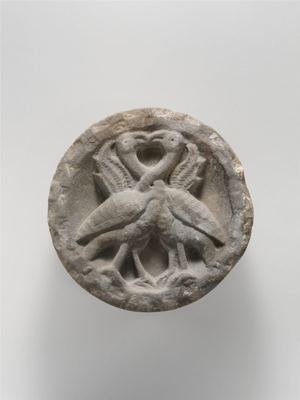
In the pictureOn a round marble slab, two birds stand facing each other, their necks crossed and beaks touching. Their wings and tail feathers are carved in relief, there is a leaf shape beneath their feet, and a shallow border runs around the edge. The surface is worn smooth. It is 28 cm in diameter.
BackgroundTwo birds with crossed necks are a motif that passed from Byzantium to Venice, and setting roundels like this into the walls of Venetian palaces was a fashion of the 12th and 13th centuries. Marble from Mount Pentelikon near Athens is the stone used for ancient Greek temples, and marble stripped from older buildings may have been reused here. The two birds signify harmony or a married couple.
Puzzle tipThe round slab stands out clearly against the pale background, so lay the outline pieces of the circle around first. Fill in the birds' heads, crossed necks and wing feathers inside, and judge the positions of the plain marble pieces by their shadows. 24 or 48 pieces works well.
- Culture
- Italian
- Classification
- Sculpture-Architectural
- Medium
- Marble (Pentelic marble from mouth Pentelikon, Athens (Greece))
- Dimensions
- 28.3 x 12.4 cm
- Credit line
- Rogers Fund, 1909
Source: The Metropolitan Museum of Art ↗
Stories about this work
- From Andirons to Wall Tiles: Five Medieval Objects Without a Single Saint
No saints, no kings. Iron that held up firewood, tiles that covered walls, a marble roundel that decorated a building. Everyday objects and architectural ornament from the Middle Ages that are not religious art.