Diptych with Scenes from the Passion
An ivory diptych about 4 cm square: a 15th-century French portable devotional object carved with Passion scenes under Gothic arches, small enough to fit in a palm. Full commentary ↓
Couldn't load the puzzle image.
Turn on piece outlines to see piece positions on this picture too
Drag the pieces into place · When zoomed in, drag an empty spot to move around
You can also play with a keyboard — Tab to the board, thenSpace pick a piece, Arrow keys move it (with Shift for small steps),Esc deselect, R rotate a piece (Shift+R the other way)
Diptych with Scenes from the Passion is an ivory or bone object by an unknown maker (15th century) in the collection of The Metropolitan Museum of Art. It measures 4.1 × 3.9 cm.
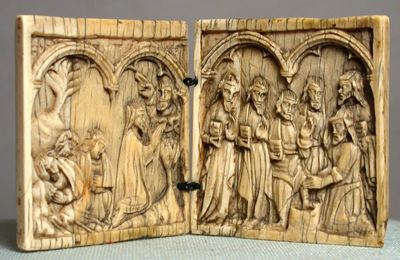
In the pictureTwo ivory panels joined by hinges open like a book. A pointed Gothic arch is carved at the top of each panel, and below it many figures are densely carved. The left panel shows a figure kneeling beneath a tree with standing figures, and the right panel a group of standing figures in long, trailing robes. Its actual size is only a little over 4 cm square, much smaller than it appears in the photograph.
BackgroundIvory diptychs like this were personal devotional objects, made mainly in Paris in the 14th and 15th centuries and spread throughout Europe. Folded, they fit in a pocket; opened, they let the owner pray while looking at scenes of Christ's Passion. Carving several figures into such a small field required skill on the scale of millimeters. The left scene appears to be the Prayer in the Garden of Gethsemane, and the right one Christ being led away or put on trial.
Puzzle tipThe yellowish color of the ivory covers everything, so color won't solve it. Start with pieces whose shapes are clear, such as the hinges and the dark gap between the panels, the curves of the arches and the straight panel edges, then fill the inside by comparing the figures' faces and the direction of their drapery folds with the preview. 48 pieces or fewer works well.
- Culture
- French
- Classification
- Ivories-Elephant
- Medium
- Elephant ivory with iron hinges
- Dimensions
- 4.1 × 3.9 cm
- Credit line
- Bequest of Nanette B. Kelekian, 2020
Source: The Metropolitan Museum of Art ↗
Stories about this work
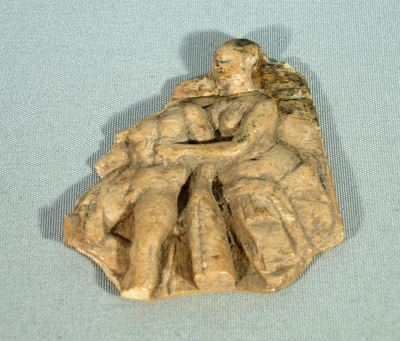
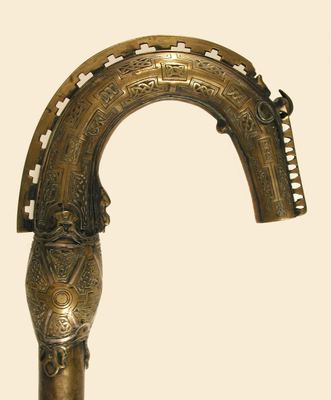
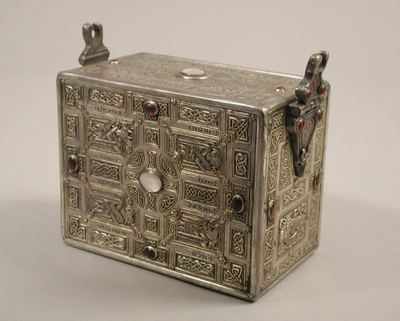
- A Story in the Palm of Your Hand: Three Medieval Ivories and Holy Objects
Most medieval art is small. Why it had to be, how to use zoom to read carvings on tiny surfaces while you assemble them, and advice on difficulty.
- What "Unknown Artist" Means, How It Is Written in English, and Why 149 Met Works Have No Name
"Unknown artist" means the maker of a work is not known or was never recorded. Here is how the Korean terms jakga misang and jakja misang differ, the English labels (Unknown, Anonymous, Attributed to), and examples from 149 museum works.